
Oriiz explores the often overlooked achievements of pre-colonial African societies, highlighting the monumental legacy of the Walls of Benin and other engineering marvels.
For centuries, the dominant narrative of human civilisation has been disproportionately shaped by a selective historical perspective. This view has often marginalised and overlooked the remarkable achievements of pre-colonial African societies. The continent was frequently portrayed as a passive receiver of culture and technology, rather than what it truly was: a vibrant and dynamic birthplace of empires whose architectural, administrative, and engineering prowess not only rivalled but often surpassed that of their contemporaries across the globe (Connah, 2001).

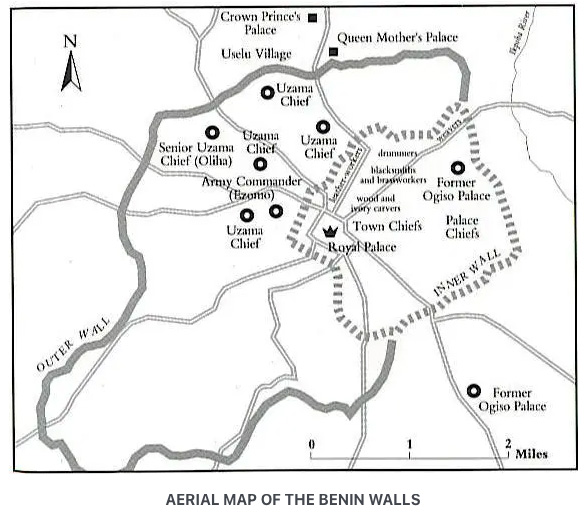
Initiated by the Edo people as early as 800 AD and developed over many centuries, the Walls of Benin stand as one of the most impressive and enduring architectural feats in human history (Bondarenko & Roese, 1999). To simply call them “walls” is a considerable understatement that does not do justice to their complexity. In reality, they were a sophisticated, fully integrated system of tall ramparts and deep, strategically placed moats, arranged in concentric rings extending from the sacred core of the royal palace. This was not a haphazard or primitive fortification; it was a clear expression of advanced urban planning, hydraulic engineering, and meticulous defensive strategy. The city’s layout was embedded in this structure, guiding movement, function, and social hierarchy.
The innermost rings were designated to protect the Oba’s palace, the spiritual, political, and administrative heart of the kingdom, along with the noble residencies. These central areas were fortified with legendary defences, the secrets of which are still studied today.
Archival materials and recent analysis show that these internal walls were constructed using a unique composite material: local earth carefully mixed with palm oil. This clever formula triggered a chemical reaction during drying that transformed the mixture, hardening the walls to a consistency similar to concrete. The result was “a near cement-like consistency as well as resilience” that proved notably resistant to both tropical erosion and European cannon fire (ThinkAfrica).
This was far more than simple mud and straw. It was a deliberately engineered chemical solution designed for maximum defensive utility and durability, demonstrating a deep, sophisticated understanding of local material properties. This is a hallmark of advanced engineering.
Nonetheless, this clever local solution was only the impressive core of a much larger, almost unfathomable whole.
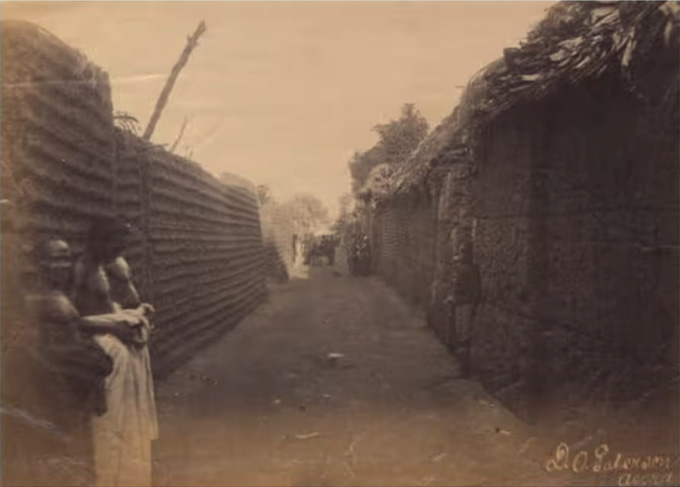
A Street Scene with Earthwork Structures in the Kingdom of Benin,
possibly captured in February 1891.
The extensive network of outer walls and ditches remains one of the largest archaeological phenomena on the planet. The effort needed to build it involved moving an estimated ‘100 million hours more earth than the Great Pyramid of Giza,’ a figure that emphasises the colossal scale of the coordinated labour involved (ThinkAfrica).
The entire system extended for about 16,000 kilometres, winding through dense forests and open plains to enclose a vast area exceeding 6,500 square kilometres. This territory is larger than many modern European countries (Bondarenko & Roese, 1999). To understand this scale, the length of the earthworks is comparable to the distance from New York to Buenos Aires. Some of the outer ramparts rose over 60 feet tall and were backed by deep, formidable ditches.
These structures served many purposes beyond simple defence. They acted as an advanced system for managing trade and movement, collecting taxes on goods entering the kingdom’s territory.
They also constructed an extensive drainage network, skillfully directing heavy tropical rains away from inhabited areas. Most importantly, they served as an unalterable, tangible symbol of the kingdom’s authority, permanence, and divine order. They were the kingdom’s infrastructure, its economic regulator, its territorial boundary, and its royal banner, all seamlessly integrated into a single, colossal earthwork that defined the Benin worldview.
Importantly, this display of engineering brilliance was not a one-off accomplishment but part of a broad regional phenomenon.
To the west, the Yoruba people of the Ijebu Kingdom built the massive Sungbo’s Eredo around the 10th century. This single, continuous 100-mile-long rampart and ditch enclosed an entire kingdom, demonstrating a comparable mastery of logistics, surveying, and communal effort (Usman, 2001).
Its construction probably involved an intricate system of labour organisation, possibly based on lineage or guild contributions, mobilising a large workforce for a communal project that defined sovereign territory and protected prosperous settlements. The simultaneous existence of Benin’s walls and Sungbo’s Eredo fully dispels any lingering myth of isolated, simple societies. These were complex, highly organised polities capable of large-scale, sophisticated territorial sculpture and landscape engineering.
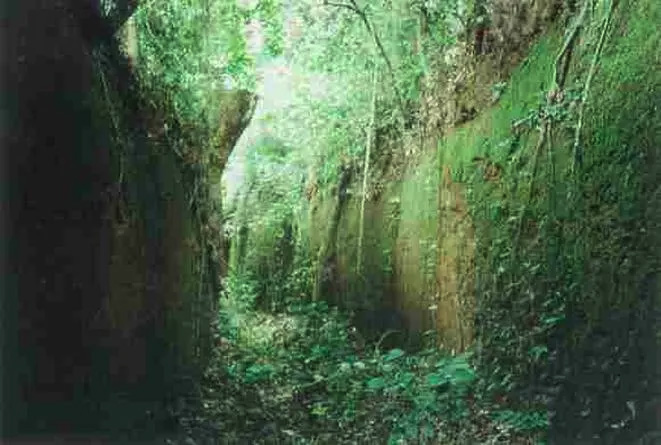
Benin Moat and Rampart Today
A Pan-African Tradition of Monumental Innovation
This tradition of monumental innovation embodies a significant yet often overlooked pan-African thread, linking diverse cultures across the continent and highlighting a shared, intrinsic drive for technological and artistic achievement that is crucial to “reshaping historical perspectives” on Africa’s past (ThinkAfrica).
Far to the south, the stone ruins of Great Zimbabwe (c. 1100-1450 AD) showcase a different but equally remarkable talent for material mastery. Here, the Shona civilisation displayed their skill not with earth, but with stone.
Shona engineers and stonemasons built elaborate, freestanding walls using precisely cut granite blocks, all fitted together with remarkable, gravity-defying accuracy and without mortar. This technique demonstrates exceptional skill and geometric understanding (The British Museum, n.d.).
The Great Enclosure, with its famous conical tower and sweeping, curving walls over 30 feet tall, stands as a clear masterpiece of aesthetic design and practical engineering. This city was much more than a village; it acted as the ceremonial and economic centre of a powerful empire that controlled the flow of gold, ivory, and other goods from the interior to the Indian Ocean coast, placing it at the centre of a vast global trade network (Pikirayi, 2001).
The city’s layout, which distinctly separated the ruler’s Hill Complex, with its religious and ceremonial functions, from the citizens’ Valley Complex below, demonstrates a sophisticated understanding of social organisation, administrative control, and a desire to harmonise with the natural environment.
In the Senegambia region, the Sereer people demonstrated their architectural expertise in a unique and equally impressive manner: through the Tumuli of Cekeen. This area, containing over 12,000 man-made burial mounds, represents a remarkable achievement in both spiritual expression and civil engineering.
Constructing these enduring, monumental hills demanded extensive coordinated labour, precise soil-compaction techniques, and expert project management to ensure their durability against the elements for centuries. They served as sacred tombs for royalty and nobility, with their size and prominence directly reflecting the status, wealth, and legacy of the buried individual.
Evidence suggests that some mounds are astronomically aligned, demonstrating an advanced understanding of astronomy and a strong desire to connect earth’s power with the celestial sky (Holl, 2006).
The collective effort needed to build these structures clearly shows a highly organised society, characterised by complex religious beliefs, a well-defined social hierarchy, and a skilled class of artisan-engineers capable of creating timeless, sacred designs.
Shared Principles: The Pillars of Advanced Society
The close link between these geographically distant sites lies in their shared, sophisticated use of three core principles: civil engineering, urban planning, and symbolic architecture. None of these structures was random or simple; each was created through careful, deliberate planning, designed to utilise the landscape to serve human needs, spiritual beliefs, and a lasting social order.
Civil Engineering formed the fundamental basis of these achievements. The builders possessed a deep, practical understanding of their materials and the laws of physics.
In Benin, they built ramparts to withstand erosion and pioneered a palm-oil composite for defence. This innovation directly “reveals the ingenuity of local material use” (ThinkAfrica).
In Zimbabwe, they mastered the complex art of dry-stone walling, ensuring structural stability, durability, and proper drainage without the use of binders. At the Tumuli, they developed sophisticated large-scale earthworking techniques and a nuanced understanding of soil mechanics.
Each of these projects demanded advanced skills in surveying, logistics, water management, and the administration of large, coordinated workforces. All of these are essential, defining pillars of civil engineering that stand against any idea of technological stagnation.
Urban planning was another crucial element, demonstrating that these were well-organised administrative states. These impressive structures formed the centre of structured city life and territorial control.
In Benin, the concentric rings clearly marked specific zones for administration, specialised craft production, trade, and residential areas. This established a framework that supported good governance, economic activity, and social hierarchy. The walls functioned as a comprehensive system for “drainage, trade regulation, and territorial demarcation” (ThinkAfrica), showing they were as essential for managing a busy, complex city as for defending it.
At Great Zimbabwe, the distinct separation of the royal, ceremonial, and commoner complexes illustrates a sophisticated ideology of how society should be organised, governed, and spatially arranged for both practical and symbolic purposes.
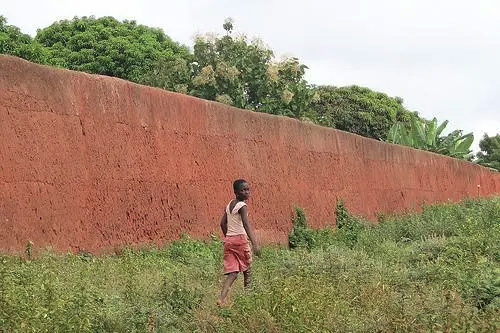
A remaining section of the Great Walls of Benin,
a massive network of earthworks in Edo State, Nigeria.
Finally, Symbolic Architecture was the powerful, unseen layer that granted these structures their enduring significance. At their core, they embodied expressions of political and spiritual power displayed on a monumental scale.
The enormous, awe-inspiring scale of the Benin Walls stood as a constant physical symbol of the Oba’s divine authority and the kingdom’s undefeated strength. The fortified, impregnable palace walls conveyed a dual message of technological superiority and resilience against potential enemies.
Similarly, the vast, unmortared stone walls of Great Zimbabwe served as unshakeable symbols of the state’s legitimacy, wealth, and permanence. These were meant to evoke the same awe and respect as the great monuments of Egypt or medieval Europe. The Tumuli of Cekeen, in turn, linked earthly rule to the ancestors and the cosmic order, anchoring secular power in spiritual legitimacy and the eternal cycle of life.
In every instance, the aim was to inspire admiration and uphold the social order, a purpose equally vital as any practical role.
Legacy and Conclusion
The great empires of pre-colonial Africa did not simply exist; they left a profound legacy of power, ingenuity, and mastery across the continent. This history is etched in earth and stone, warranting recognition not as a marginal note but as a central monument in our shared human history.
By embracing the true, astonishing scale of these achievements — such as the sobering fact that the Walls of Benin required moving a volume of earth that significantly “surpassed that of the Great Pyramid of Giza” (ThinkAfrica) — we do more than amend an outdated historical record. We actively reveal a profound and empowering legacy of African innovation in “civil engineering, urban planning, and symbolic architecture” (ThinkAfrica).
This legacy is hardly just a remnant of the past. It serves as a powerful testament to human potential, challenging enduring stereotypes and offering a profound source of pride and inspiration. It commands respect for the intellectual history of the African continent and acts as a driving force for innovation, demonstrating that principles such as large-scale project management, sustainable material use, and visionary urban design are well-established and can propel progress for generations to come. Recognising these marvels is essential for developing a truly complete and honest understanding of our shared global heritage.
Works Cited
- Bondarenko, D. M., & Roese, P. M. (1999). *Benin Precolonial Urbanism: A Summary of the Archeological Evidence.*
- Connah, G. (2001). *African Civilizations: An Archaeological Perspective* (2nd ed.). Cambridge University Press.
- Holl, A. F. C. (2006). *West African Early Towns: Archaeology of Households in Urban Landscapes.* Ann Arbor: Museum of Anthropology, University of Michigan.
- Pikirayi, I. (2001). *The Zimbabwe Culture: Origins and Decline of Southern Zambezian States.* AltaMira Press.
- ThinkAfrica. (n.d.). “The Walls of the Great Benin Kingdom: A Civil Engineering Wonder.” *ThinkAfrica*. https://thinkafrica.net/walls-of-benin/. Accessed 6 March 2026.
- The British Museum. (n.d.). “Great Zimbabwe.” The British Museum. https://www.britishmuseum.org/collection/galleries/great-zimbabwe.
- Usman, A. A. (2001). *The Yoruba Frontier: A Regional Perspective on Ijebu and Its Neighbours.* (Example stand-in for a source on Sungbo’s Eredo).

Oriiz is a Griot, Curator, Designer, Culture Architect, and Strategist who makes African history portable and accessible to everyone: those who know, those who question, and those who never thought to ask. He connects 8,000 years of knowledge with the present. Oriiz also edited and served as Executive Producer for The Benin Monarchy: An Anthology of Benin History (The Benin Red Book), Wells Crimson, 2019. Author: The Harbinger: A Window into the Soul of A People: 8000 years of Art in Nigeria, Crimson Fusion (2025).
:::::::: oriiz@orature.africa IG: @oriizonuwaje
