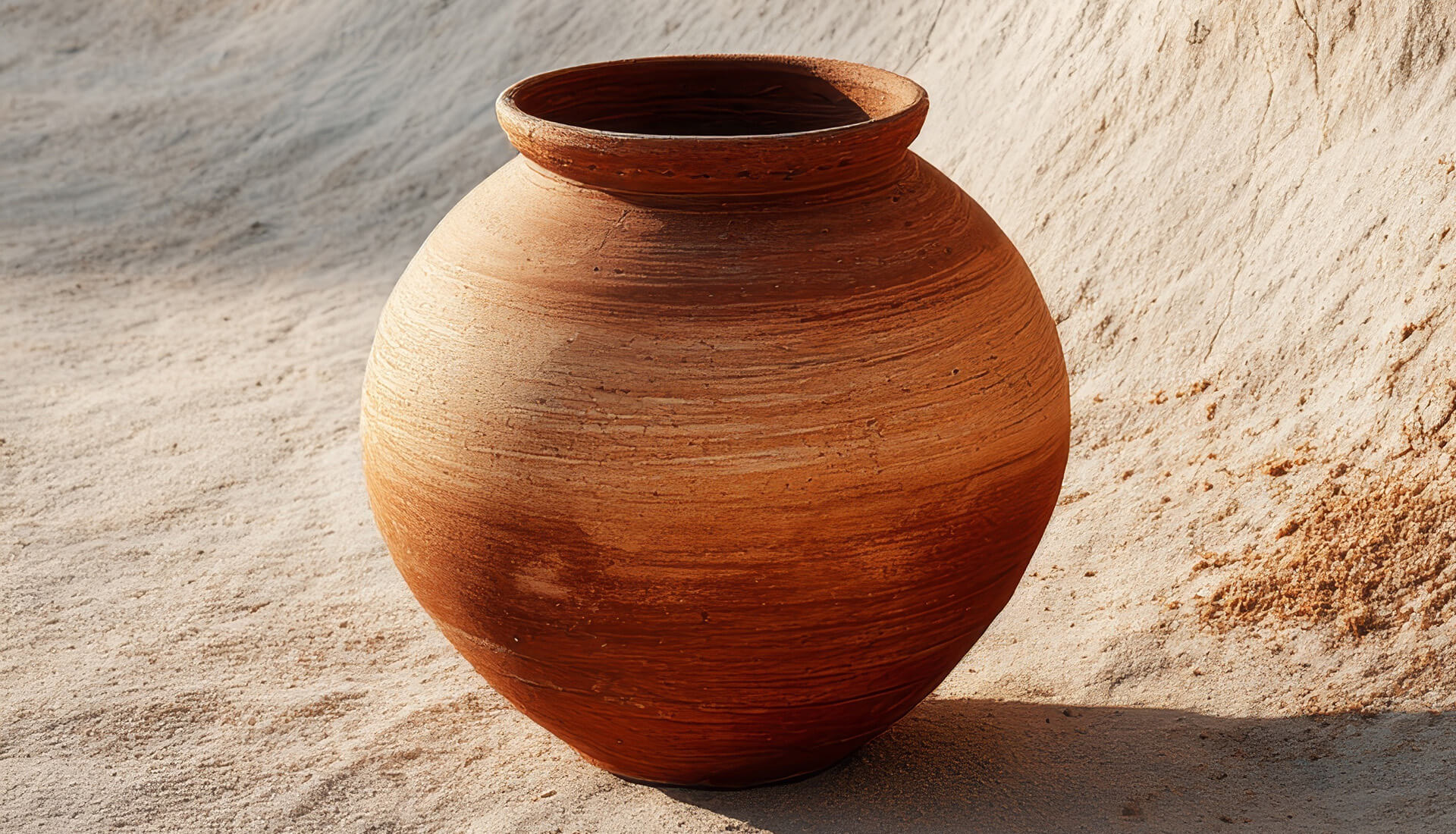
Earth, Shaped into Meaning:
Symbolism and Aesthetics of Pottery in Nigeria

By Oriiz U Onuwaje

Oriiz examines the symbolism and aesthetics of pottery in Nigeria, exploring how artisans transform earth into objects rich with meaning. This essay delves into traditional techniques, cultural motifs, and artistic expressions that define Nigerian pottery, revealing how these crafted vessels embody the values, beliefs, and creativity of their makers. In Nigeria, clay is not just shaped by hand, but also by heritage and imagination.

Download PDF version of Essay

Introduction

Pottery in Nigeria has a subtle yet lasting presence. Unlike bronze or monumental sculptures, which stay distant, pottery is tightly woven into everyday life. It appears in people’s hands, by the hearth, in courtyards, and at shrines. Such presence speaks softly but persistently through every household.

A clay vessel may seem simple. Look deeper. Fine details like shape, weight, and texture reveal purpose. Pottery is not only useful; it is beautiful, meaningful, and cultural. Fired clay combines labour, memory, and significance.

In many Nigerian cultures, pottery combines art with daily life. Clay becomes pots used for cooking, storage, cooling, and rituals. Each piece is crafted with care. Beauty is inherent in the design. Use and shaping coalesce, strengthening pottery’s connection to function and significance throughout history.

Pottery and Nok and Ife Terracottas

Pottery represents a tradition of deliberate earth-shaping. Nok terracottas from Nok and Taruga, in today’s Kaduna State, exemplify this. Skilled and meticulous hands shaped the clay. The evidence remains. Bernard Fagg uncovered this history.
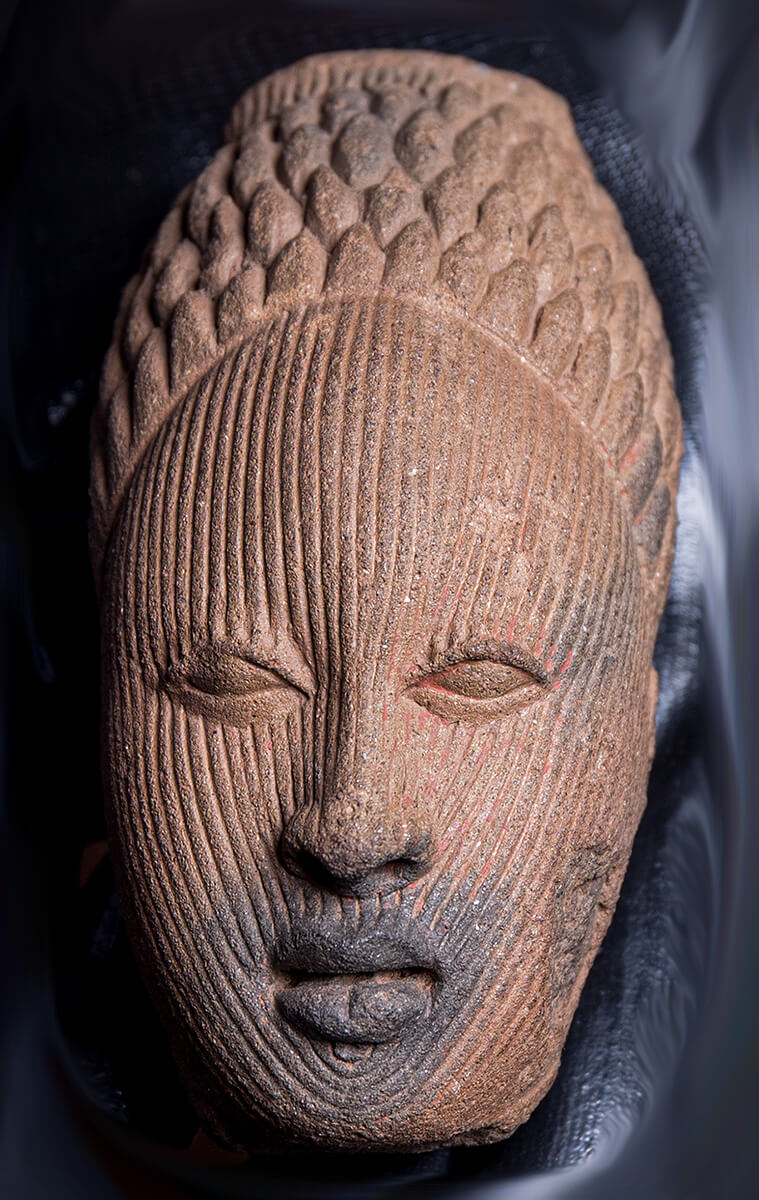
Ife Head

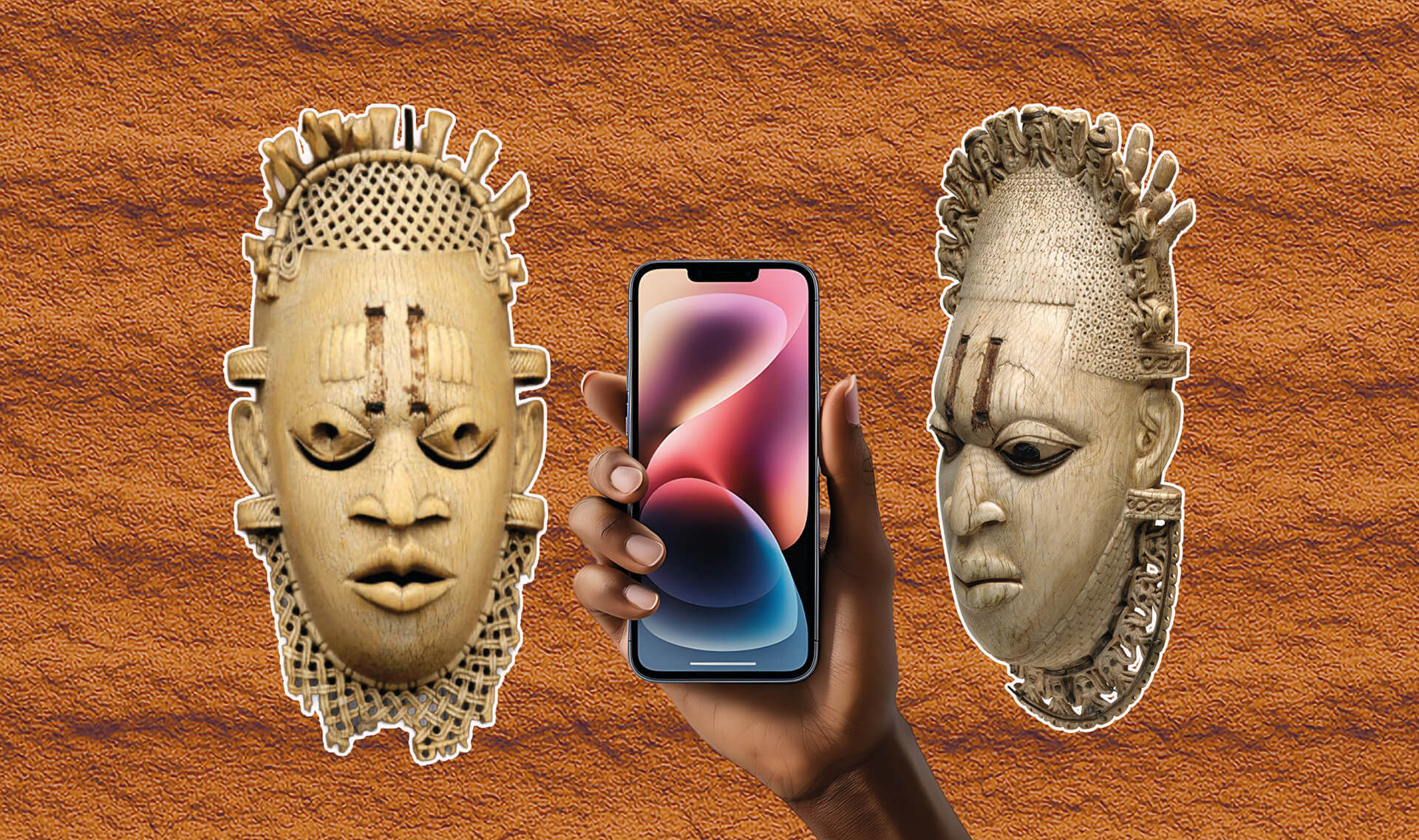
IfeTerracotta Miniature Queen Head – 12 AD

Though Nok’s works are mainly sculptures, they belong to this tradition. They demonstrate clay’s importance and its ability to convey structure and meaning.

The terracottas of Ile-Ife in present-day Osun State also demonstrate this sophistication. These intricate, naturalistic works appear in sacred and royal settings. They affirm that earth can be transformed into profoundly meaningful objects.

There is no straightforward path from Nok to Ife or subsequent pottery styles. Nonetheless, they all form part of a wider tradition where clay is shaped intentionally. Looking at them together helps clarify the nature of pottery.

Unlike terracotta sculptures, pots serve everyday people. They are used daily to store water, cook, keep grain, and hold ritual items. This connection to daily routines gives pots special significance. Each one is always present, always nearby.

Form and Aesthetic Structure in Pottery

Pottery’s beauty starts with its proportions. Before decorating, we notice the opening, neck, body, and base, all of which are carefully crafted. A well-made pot feels balanced and sturdy.

Here, harmony comes from structure, not decoration. This gives the pots a quiet strength that lasts. In places like Kwali, Suleja, and Oyo, this carefully planned approach is clear. Pots may be big, but never too much. Their strength comes from proportion, not showiness.
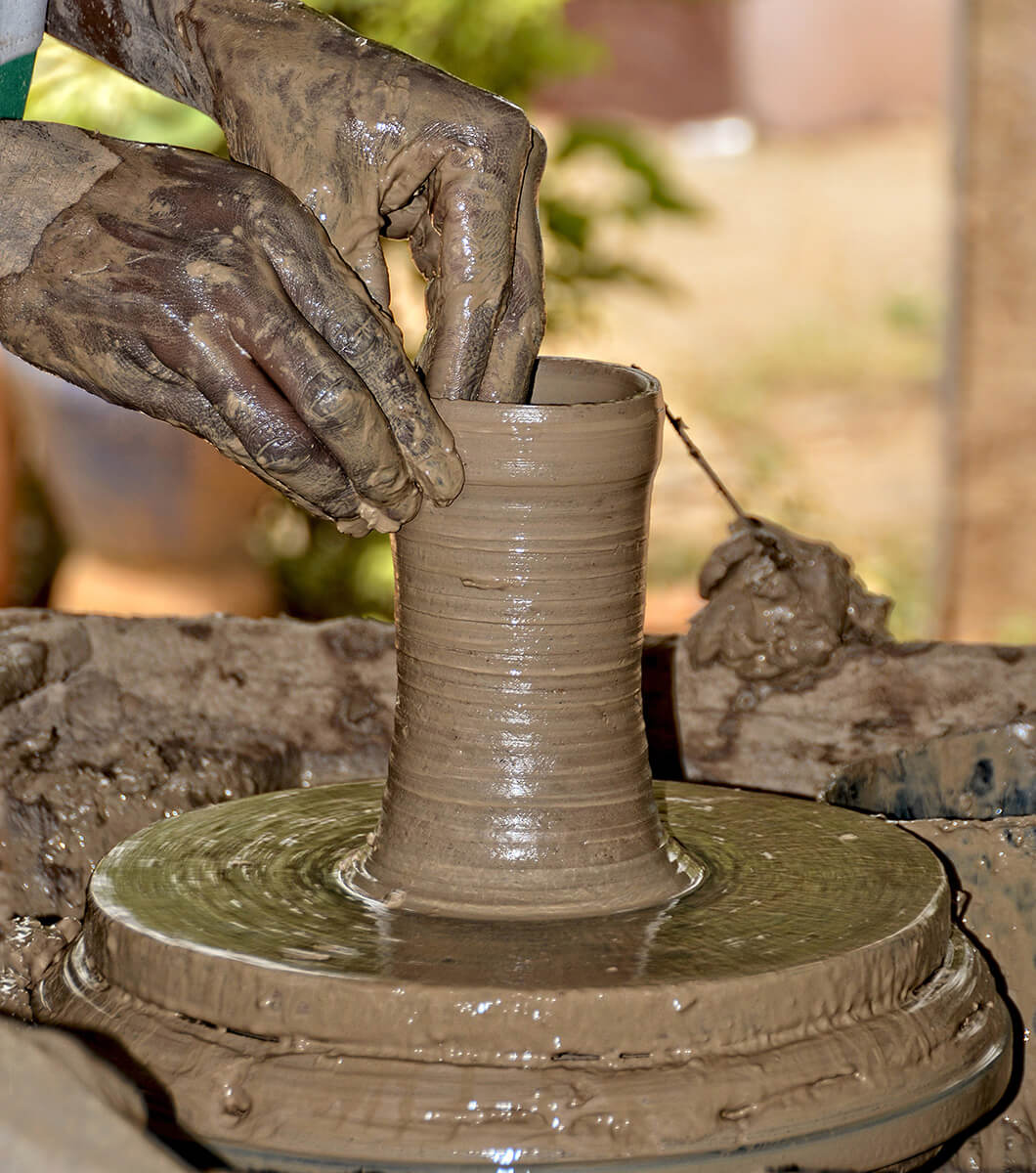
Potter

Surface Treatment and Decorative Language

The way the surface is finished adds even more significance. Nigerian potters use techniques such as burnishing, carving, ridging, and patterns. Each technique influences how people perceive the pot. The details go beyond decoration; they draw attention and invite interpretation.

A shiny surface indicates refinement, while a smooth, glossy surface demonstrates skill. Lines carved into the pot can emphasise its shape; repeated patterns create rhythm and movement. Decoration always complements the pot’s form, maintaining balance and unity. Specific motifs on pots signal identity, heritage, or lineage. For example, spiral or wavy lines often represent water sources or fertility. They act as visual markers, identifying a community or reflecting the potter’s family background. In certain contexts, a vessel’s rounded body suggests fertility, containment, and sustenance. Therefore, the form connects to its meaning.
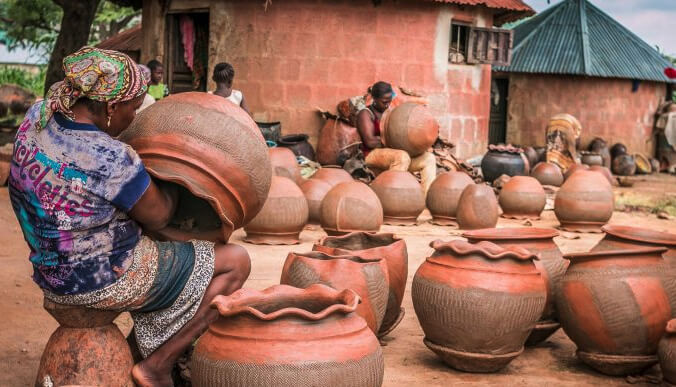
Ushafa Cultural Pottery Centre

Ushafa Cultural Pottery Centre

Meaning differs across communities. What makes sense in one may not in another. Pottery resonates most strongly with those who share its traditions.

Pottery in Yoruba Culture: Oyo Context

In Yoruba culture, particularly in Oyo, pottery plays a role both at home and in rituals. Pots are used for cooking and storage, and they are also found in shrines dedicated to orisa.
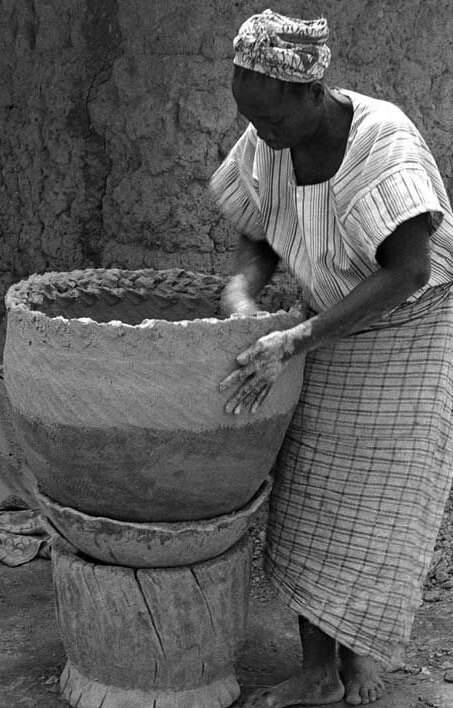
Oyo State Pottery
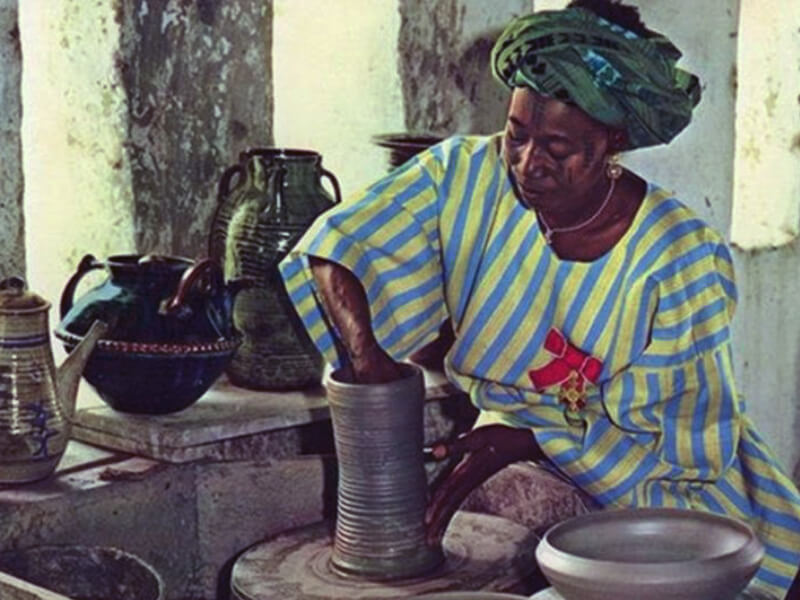
Ladi Dosei Kwali

In rituals, pots gain greater significance within a spiritual system. The design stays deliberate and straightforward, with restrained shapes and surfaces. Beauty is disciplined, not ostentatious.

Women and the Transmission of Pottery Knowledge

Women have played a vital role in Nigeria’s pottery. In many communities, they preserve the knowledge of sourcing clay, preparing it, and creating and firing pots. Their efforts shape the tradition. They are its guardians.
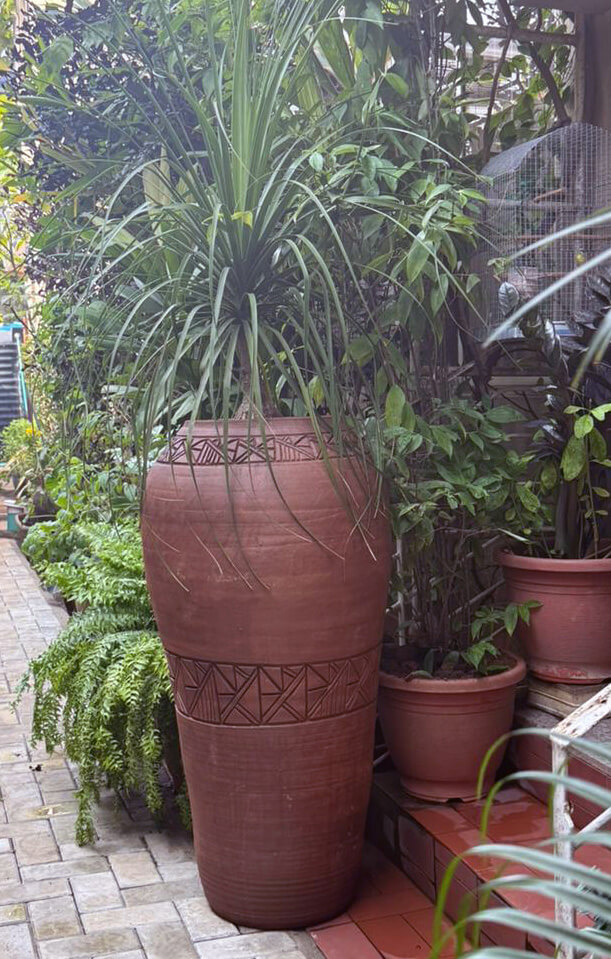
Flower pot by Akinpotter

This knowledge is gained through doing, not reading. It is passed on by watching, practising, and learning from mistakes. It demands skill and a keen eye for beauty. Although often overlooked, the tradition continues vibrantly.

Ladi Kwali and the Expansion of Visibility

Ladi Kwali stands out in this tradition. Born in Kwali, near Abuja, she became Nigeria’s most
renowned potter. Her pots are sturdy, well-shaped, and often feature carved patterns.
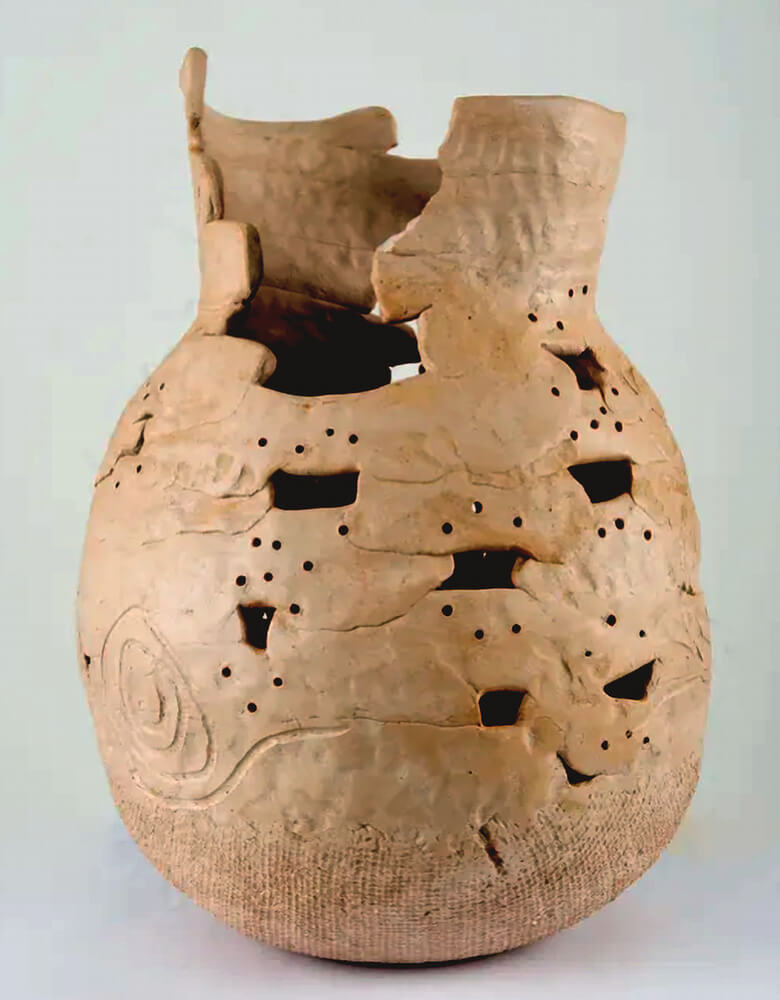
Chris Echeta, 2019. Terracotta, engobe and aluminum

Chris Echeta, 2019. Terracotta, engobe and aluminum

By collaborating with Michael Cardew at the Abuja Pottery Training Centre in Suleja, Ladi Kwali expanded her reach to wider audiences. More importantly, she preserved and advanced the tradition. She reached new audiences. She honoured her roots. The Abuja Pottery Training Centre became a key gathering place. Local traditions blended with modern studio techniques, and traditional pottery-making practices were influenced by wider ideas about ceramics. Old met new. The exchange transformed both.

This did not replace old methods, but complemented them. Abuja combined traditional knowledge with modern techniques, linking local pottery to wider art forms.
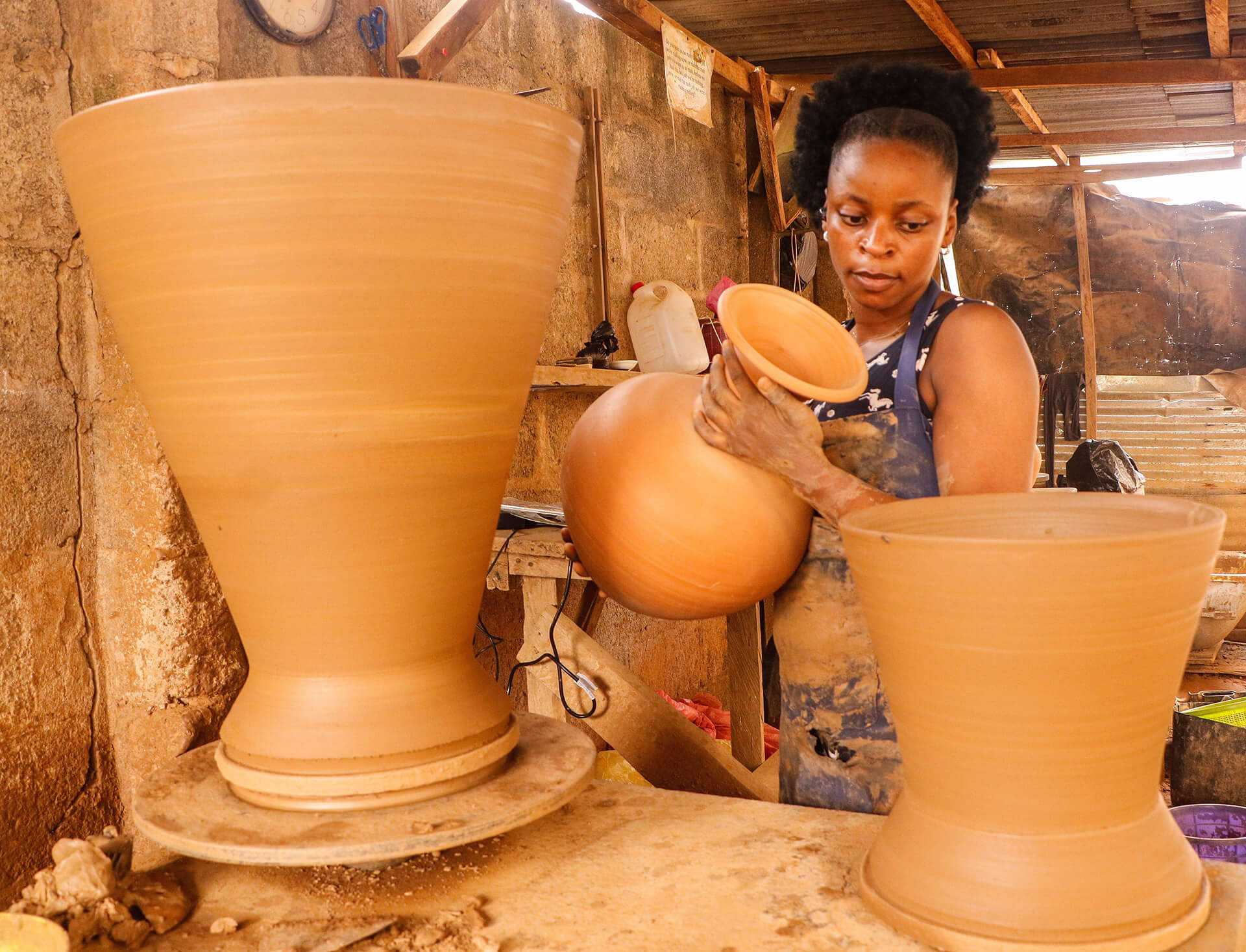
Craftswoman Olugbade Adekemi makes clay pots using traditional methods at her local pottery workshop in a suburb of Lagos.

Contemporary Ceramics in Nigeria

Ceramics in Nigeria continue to develop. This momentum persists across various centres of artistic production. Universities and art schools in Nsukka, Zaria, Ile-Ife, and Lagos have maintained ceramics as a vital area of study. Potters such as Benjo Igwilo, Chris Echeta, and Akinpotter of Ibadan demonstrate that clay remains a lively medium. Some closely follow traditional vessel forms; others explore sculptural or experimental paths. What unites these practices is an awareness that clay is not limited. It remains open to new interpretations.

Regional Diversity in Pottery Traditions

There is no single Nigerian pottery tradition. Practices differ across regions such as Afikpo, Oyo, Kwali, the Benue Valley, and the Lower Niger. Conditions influence not only the materials but also the forms and uses. Each region leaves its own mark.

This variety embodies richness, not fragmentation. It demonstrates pottery’s flexibility in adapting to cultural and natural contexts.

Function and Artistic Integration

In pottery, both function and beauty are intertwined. Cooking pots, water vessels, and ritual containers are crafted specifically for their intended uses.
Beauty arises from harmony between use and form. It does not appear afterwards but develops from the pot’s purpose.

Material Transformation and Philosophical Meaning

Clay is a powerful symbol. Extracted from the earth, shaped by water, pressure, air, and fire, it begins as formless and flexible, then becomes strong and enduring. The process is simple but profound. Clay’s transformation reveals a larger idea: nature isn’t merely exploited but reshaped. Pottery illustrates this process clearly.

Clay’s transformation reveals a larger idea: nature isn’t merely exploited but reshaped. Pottery illustrates this process clearly.

Contemporary Challenges and Continuity

Today, pottery faces new challenges. Modern materials are everywhere. Lifestyles are changing. People are using traditional pots less. Consequently, passing down pottery skills is no longer guaranteed. The future depends on adaptability. The tradition stands at a crossroads.

Yet pottery persists. It endures by evolving while maintaining its core principles.

Conclusion

Pottery in Nigeria still holds great significance. From Nok and Ile-Ife terracottas to the pots of Oyo and Kwali, and today’s art, clay remains vital. Pottery is more than just a container. It records ideas, labour, and change. In decorated clay, we find not only objects but a lasting testament to the human desire to express, create, and preserve meaning.


Oriiz
Oriiz is a Griot, Curator, Designer, Culture Architect, and Strategist who makes African history portable and accessible to everyone: those who know, those who question, and those who never thought to ask. He connects 8,000 years of knowledge with the present. Oriiz also edited and served as Executive Producer for The Benin Monarchy: An Anthology of Benin History (The Benin Red Book), Wells Crimson, 2019. Author: The Harbinger: A Window into the Soul of A People: 8000 years of Art in Nigeria, Crimson Fusion (2025).
:::::::: oriiz@orature.africa IG: @oriizonuwaje
The Architecture of Value:
Cowrie Shells, Manillas, Iron Bars and Cloth as Currencies

By Oriiz U Onuwaje

Oriiz explains how pre-colonial Nigerian societies established a monetary system using cowrie shells, manillas, iron bars, and cloth. This monetary system was a comprehensive economic framework based on trust and innovation, supporting trade and integrating markets into social and political life long before colonisation.

Foundation of Daily Trade: Cowrie Shells

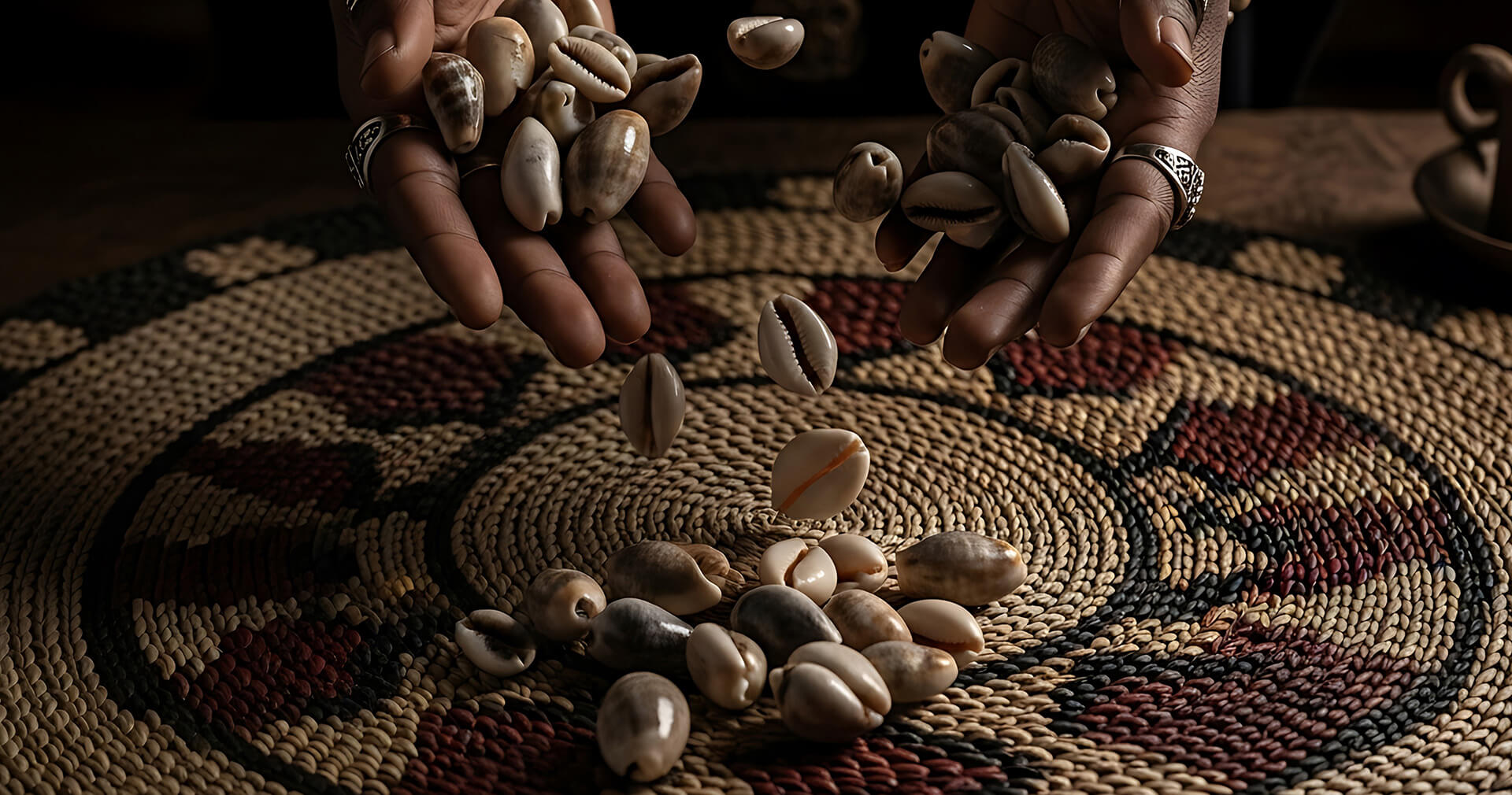
Cowrie shells (primarily Cypraea Moneta) served as the basis for daily exchanges and minor debts in pre-colonial Nigeria. Cowries were durable, divisible, and portable. These qualities made cowries ideal for small transactions and minor debts. They arrived in Nigeria in the 15th century via trans-Saharan and European trade. Their value was socially established and widely accepted among groups such as the Yoruba, Hausa, and Edo.

Download PDF version of Essay

Numeracy skills were essential for handling cowries. The Yoruba and Hausa developed sophisticated counting systems, demonstrating their mathematical abilities. Additionally, the quality of the cowries was important. Cowries were graded based on size, shine, and completeness. Larger, shinier, and fully intact cowries commanded higher prices. This grading system acted as an early form of quality control and a way to preserve value.

Cowries were incorporated into the economic activities of regions such as the Kingdom of Benin and the Oyo Empire. Cowries were used to pay taxes and fines, and to make offerings to the gods. By integrating cowries into the administrative and spiritual fabric of society, the economic systems of these regions developed a common economic language that facilitated trade across culturally distinct areas. As a result of the widespread adoption of cowries, the regional economies of the area became interconnected economically.

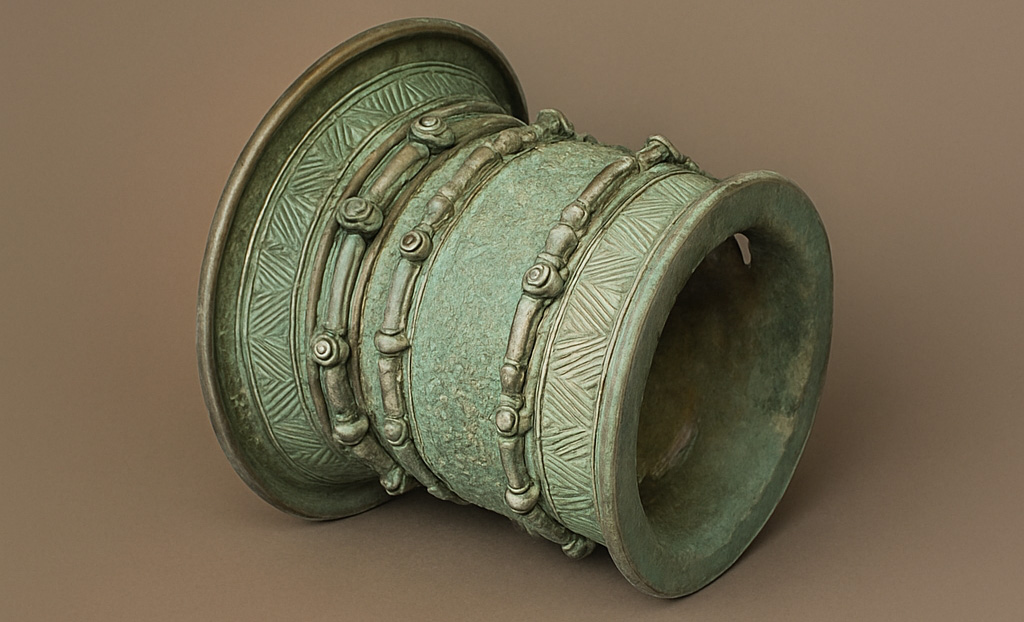
Manilla

For Major Transactions: Manillas and Iron Bars

Because large transactions such as buying land or paying dowry required vast quantities of cowries, the cowrie-shell system became impractical for these purposes. A newer form of currency, more valuable and easier to carry, was necessary. Two types of currency fulfilled these criteria: manillas and iron bars. Both are examples of purpose-made currencies whose worth was guaranteed through standardised manufacturing and cultural acceptance.

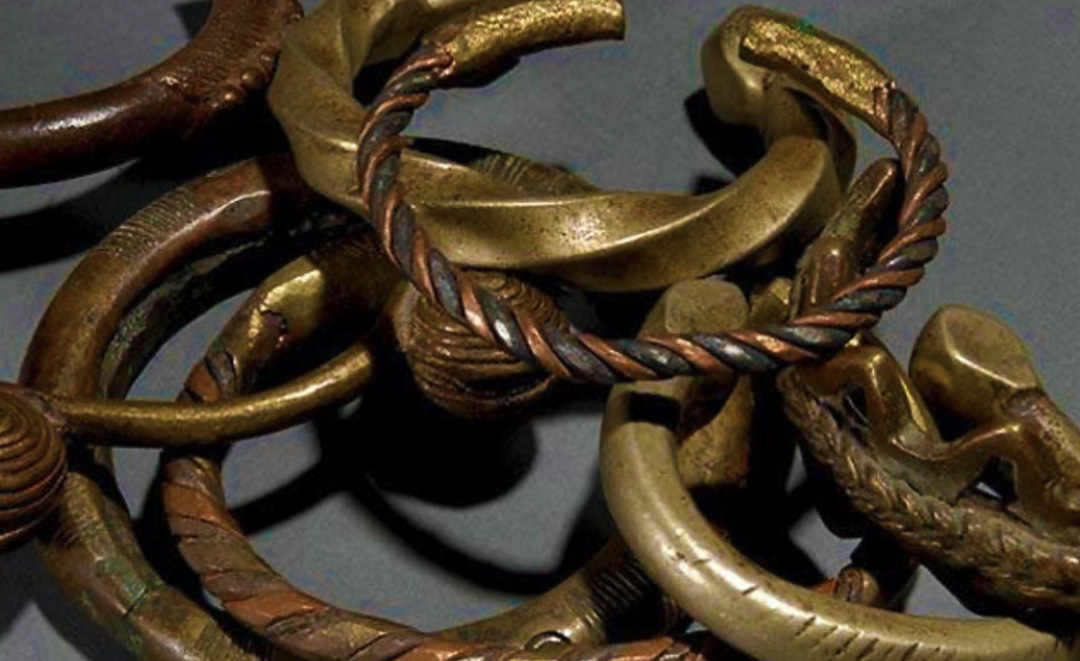
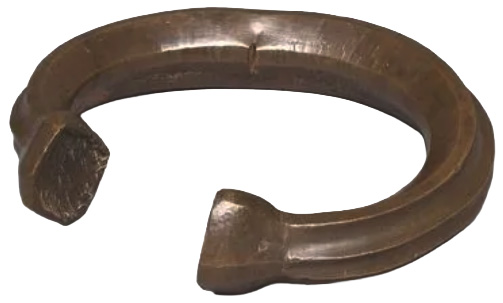
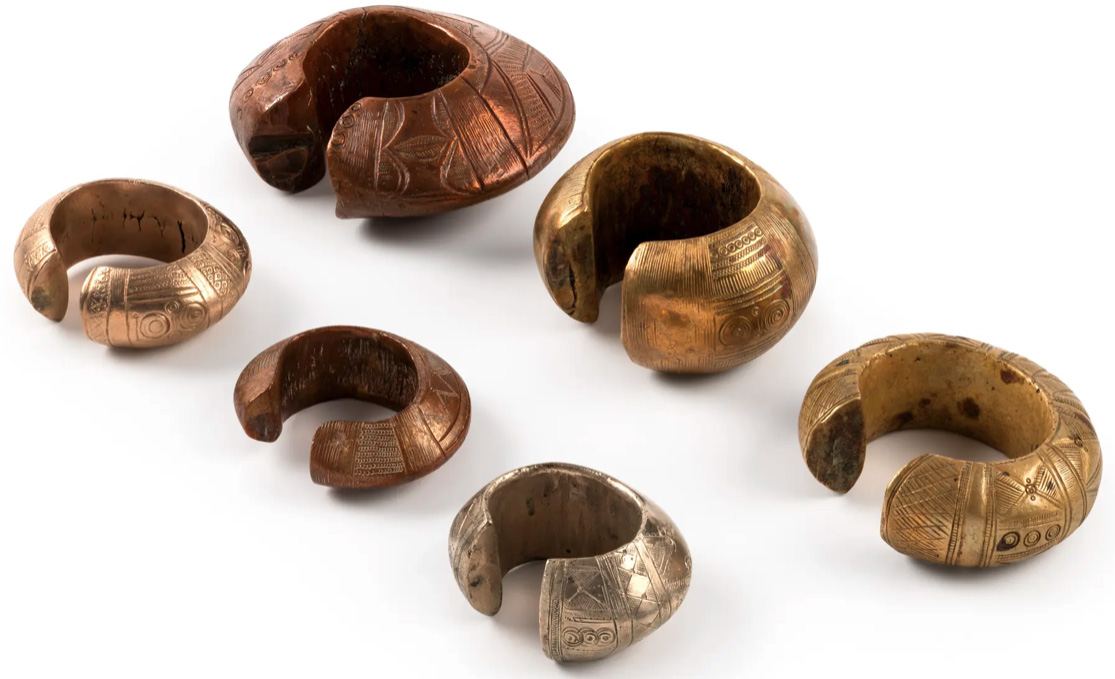
Manillas, the more popular form of currency on the West African coast from the 16th century onwards, are usually horseshoe-shaped and primarily made of brass or copper. Manillas were initially produced in Europe for trade with Africa. As manillas were exchanged along the West African coast, their design and weight were gradually standardised to suit local users’ preferences and existing value systems.

Manilla

Manillas were the preferred medium for major transactions in the Niger Delta and among the Igbo and Ibibio peoples. The value of manillas is based on the metal content and the labour required to produce them. Consequently, there is a direct link between the value of the Manilla and the craftsmanship involved in making it. Manillas have been used as displays of wealth, worn during ceremonial occasions, and created for social payments such as bride price, signifying that manillas played a role in the exchange of goods and services beyond merely serving as a medium of exchange.

Manillas were so deeply embedded in the economic system of West Africa that, even when the British colonial government introduced its own currency to the region, manillas continued to be used as currency. To put an end to the use of manillas as currency, the British government banned and demonetised them in the early 20th century. This measure led to severe economic hardship for the people of West Africa.

Manilla

Iron bars, similar to manillas, were also used as a high-value medium of exchange in other parts of West Africa. Iron bars, often shaped like a hoe or a point, were produced in standardised sizes and weights. The production of iron bars was regarded as a prestigious craft, and the finished product carried spiritual significance. Standard iron bars were valued as a measure of wealth, used as payment for various purposes, including compensation for a large plot of land, serious offences, and were regarded as part of a noble’s treasure. Unlike manillas, which were mainly used in coastal transactions, iron bars circulated widely across inland trading networks, connecting regions through a shared understanding of value rooted in both material usefulness and symbolic status.

Together, manillas and iron bars show how the pre-colonial economic system used different types of currency for various transaction levels. The use of these different currencies helped maintain economic stability and efficiency across the wide range of activities that existed in pre-colonial West Africa.

Cloth Currency: Currency of Status and Ceremony

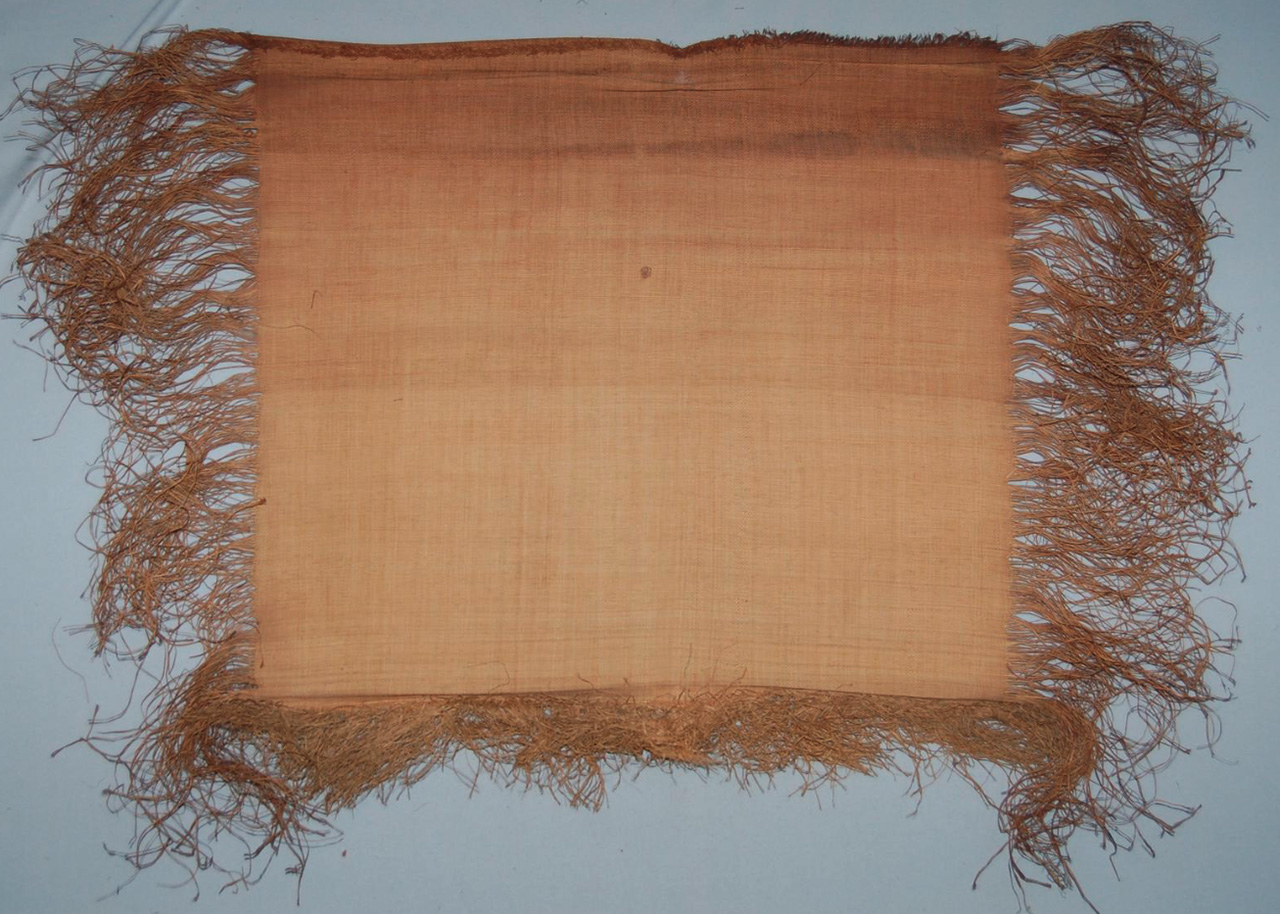
At the apex of this monetary hierarchy were textiles, specifically high-quality, handmade fabrics such as those produced by Yoruba aso-oke weavers, Nupe weavers, and Benin weavers. Cloth currency operated in a domain where economic value was inseparable from social, political, and spiritual worth.

Cloth Money

Its main function went beyond merely serving as a medium of exchange; it was a luxury item, a symbol of elite status, a medium of gift-giving in diplomacy, and a key object in many rituals and ceremonies, including weddings, funerals, and title-taking events.

The production of prestige cloth was a time-consuming, labour-intensive process that required great skill and often used expensive dyes and imported materials. Because of the difficulty in producing these cloths, their supply was limited, and their value was therefore significantly increased. One fine piece of cloth can be worth thousands of cowries or several iron bars, thereby qualifying it as a high-denomination store of wealth.

Kings and nobles amassed vast collections of these textiles as part of their treasuries. They would give cloth as rewards for loyalty, forge alliances with neighbouring kingdoms through gift exchanges, and showcase their power and generosity during public festivals. In some cultures, such as the Benin Kingdom, certain types of cloth were exclusively reserved for royalty. As a result, the value of these textiles was effectively priceless and not interchangeable in everyday trade.

Cloth holds a special place in the realm of social credits and obligations. When cloth is given as a gift, it forges a lasting bond of reciprocity and honour between the giver and

Cowries

recipient. This highlights another essential aspect of the monetary systems described earlier. The highest value in these societies did not lie in abstracted metals but in objects that embodied cultural significance, artistic worth, and social ties. Therefore, cloth is not merely a form of currency; it is the physical representation of wealth as social capital.

Marketplaces, Networks and the Underpinnings of Trust

A currency system of this complexity could not exist without a strong institutional framework. Extensive networks of marketplaces facilitated the movement of goods and the exchange of various currencies. Periodic markets, such as those in Hausaland and those organised by the Aro Confederacy in Igboland, served as centres of trade and functioned as de facto financial hubs. The prices of cowries relative to other currencies were determined at these markets, and the overall value of the currencies relative to each other was stabilised.

The Aro offered an institutional framework for the exchange of goods over long distances and established settlements across culturally diverse regions through their extensive network of diasporans and their capacity to invoke divine authority.

The entire monetary system of pre-colonial Nigeria relied heavily on a sophisticated framework of trust. This trust was deeply rooted in culture and spirituality. Economic transactions were not just individual acts but were embedded within social relationships governed by shared norms, religious beliefs, and community oversight.

Economic transactions were further safeguarded through the use of curses or oaths to ensure contract compliance, the invocation of deities associated with trade and wealth (e.g., Ogun among the Yoruba), and the moral authority of elders and titleholders to resolve disputes. This trust was sufficient to enable the operation of credit systems and forward contracting without the need for written contractual agreements.

Additionally, the currencies themselves were often consecrated through use in religious ceremonies. Cowries were offered to deities, manillas were placed on shrines, and cloth was used in ritual attire. The association of the economic with the spiritual meant that failing to uphold trust was not merely a breach of contract but a breach of moral and cosmic law. Therefore, the establishment of the pre-colonial Nigerian monetary system was as much a cultural achievement as it was an economic one.

Conclusion

The pre-colonial economic systems of Nigeria were well-organised and innovative. The layered monetary system used in these systems (ranging from cowrie shells to cloth) enabled efficient trade, the storage of wealth, and accurate valuation across society. More importantly, the monetary system was deeply interconnected with the social, political, and spiritual aspects of the societies that used it. Economic activity was not separate from cultural life; instead, it was a vital part of it, guided by mutually understood norms and supported by shared beliefs and religions.

Appreciating the sophistication of these systems will help decolonise the study of economic history and increase awareness of indigenous African innovations. The real disruption did not come from the superiority of the financial system itself, but from the colonial imposition of a system that rejected these trusted, complex systems.

The lessons from these systems can guide the development of economic systems that tackle the complexities of human needs.


Oriiz
Oriiz is a Griot, Curator, Designer, Culture Architect, and Strategist who makes African history portable and accessible to everyone: those who know, those who question, and those who never thought to ask. He connects 8,000 years of knowledge with the present. Oriiz also edited and served as Executive Producer for The Benin Monarchy: An Anthology of Benin History (The Benin Red Book), Wells Crimson, 2019. Author: The Harbinger: A Window into the Soul of A People: 8000 years of Art in Nigeria, Crimson Fusion (2025).
:::::::: oriiz@orature.africa IG: @oriizonuwaje
Three-Dimensional Databases:
The Lost-Wax Revolution

By Oriiz U Onuwaje

Oriiz examines the emergence of this technological standard, tracing its roots to intricate, highly coordinated practices that developed across West Africa over a millennium. The story of lost-wax casting is not just about technical innovation but also about enduring human ingenuity and resilience. Imagine a workshop at dusk: the glow of the fire, the rhythmic bellows of apprentices, and the careful guidance of master metalworkers, who pass down secrets refined over centuries.

This investigation demonstrates how lost-wax casting became not only a symbol of artistic and technical achievement but also a means of passing on knowledge, identity, and values across generations. The essay thus highlights the lasting influence of these ancient methods and clarifies how the techniques and philosophies of lost-wax casting continue to influence modern manufacturing and specialised craftsmanship worldwide.

Download PDF version of Essay

Origins and Cultural Significance of Lost-Wax Casting

In the annals of human creativity, few artistic revolutions demonstrate such technical mastery and cultural cohesion as the lost-wax casting tradition. This tradition thrived in West Africa from the 9th to the 19th centuries. It was not merely a technical process; it became a continent-wide standard that united diverse civilisations through shared values of precision, innovation, and symbolic communication. Art historian Frank Willett described it as “one of the most remarkable artistic achievements in human history” (Willett, 1967). These metal creations functioned as sophisticated archival systems, serving as three-dimensional databases that preserved essential knowledge long before modern books and computers.

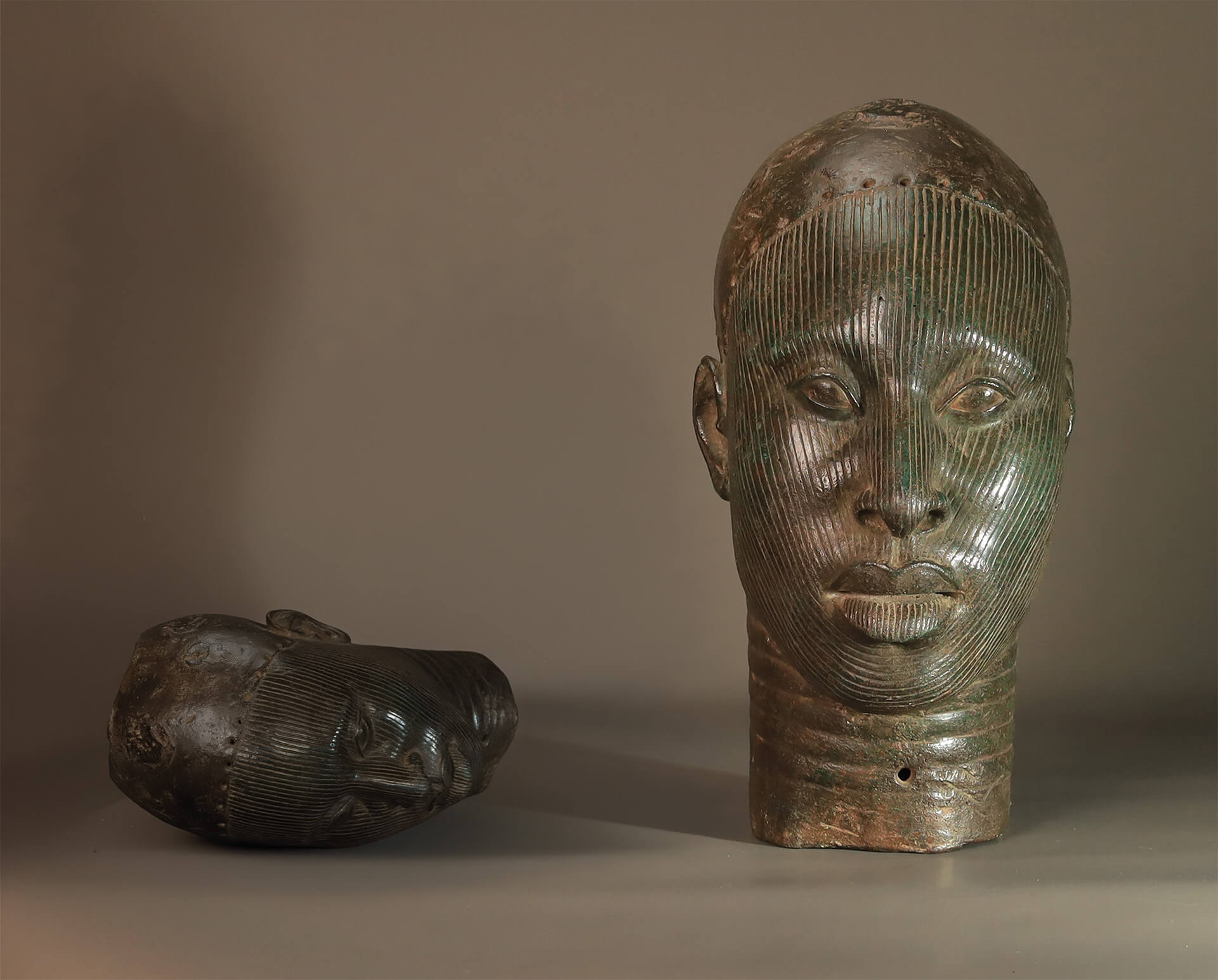
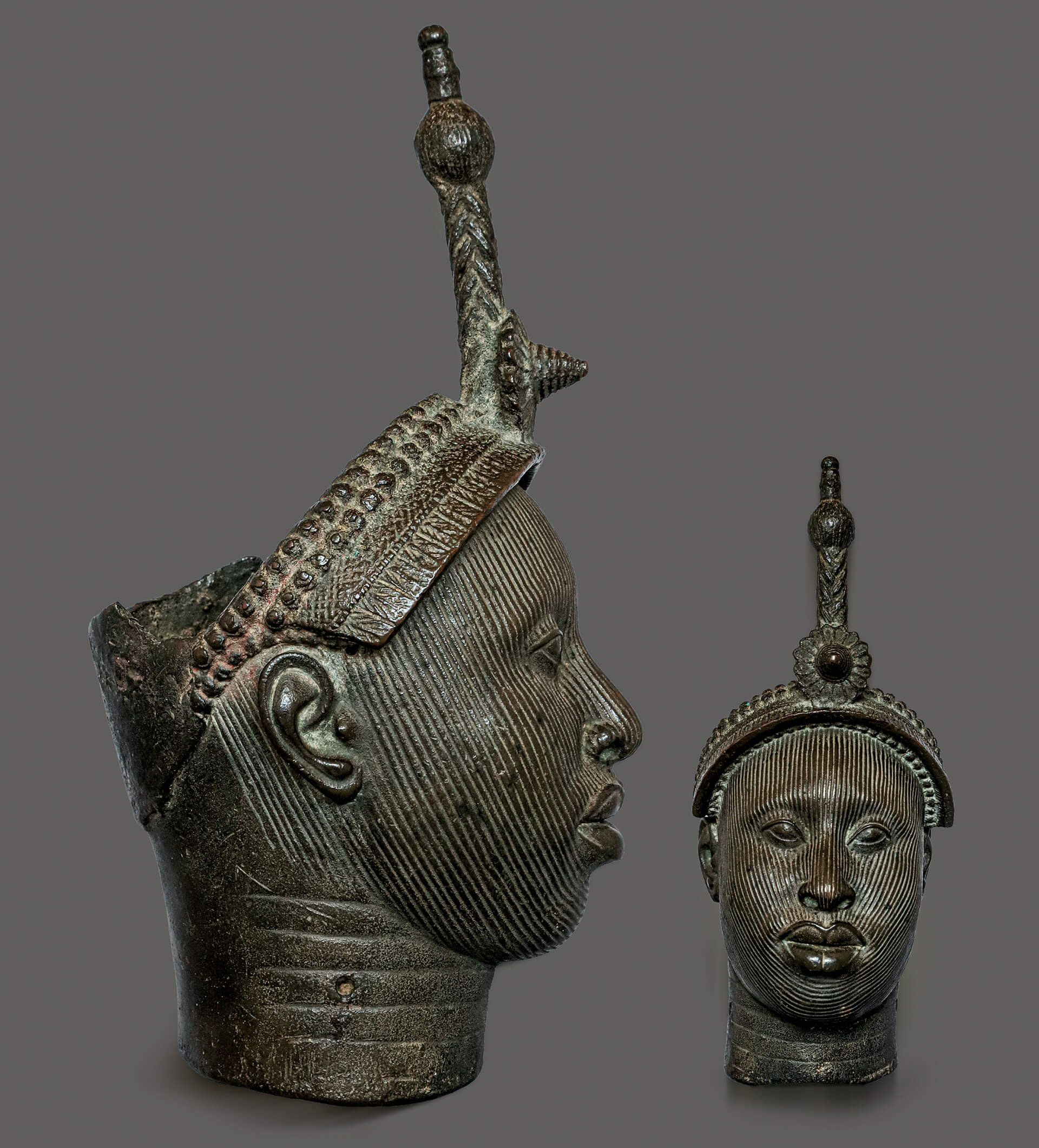
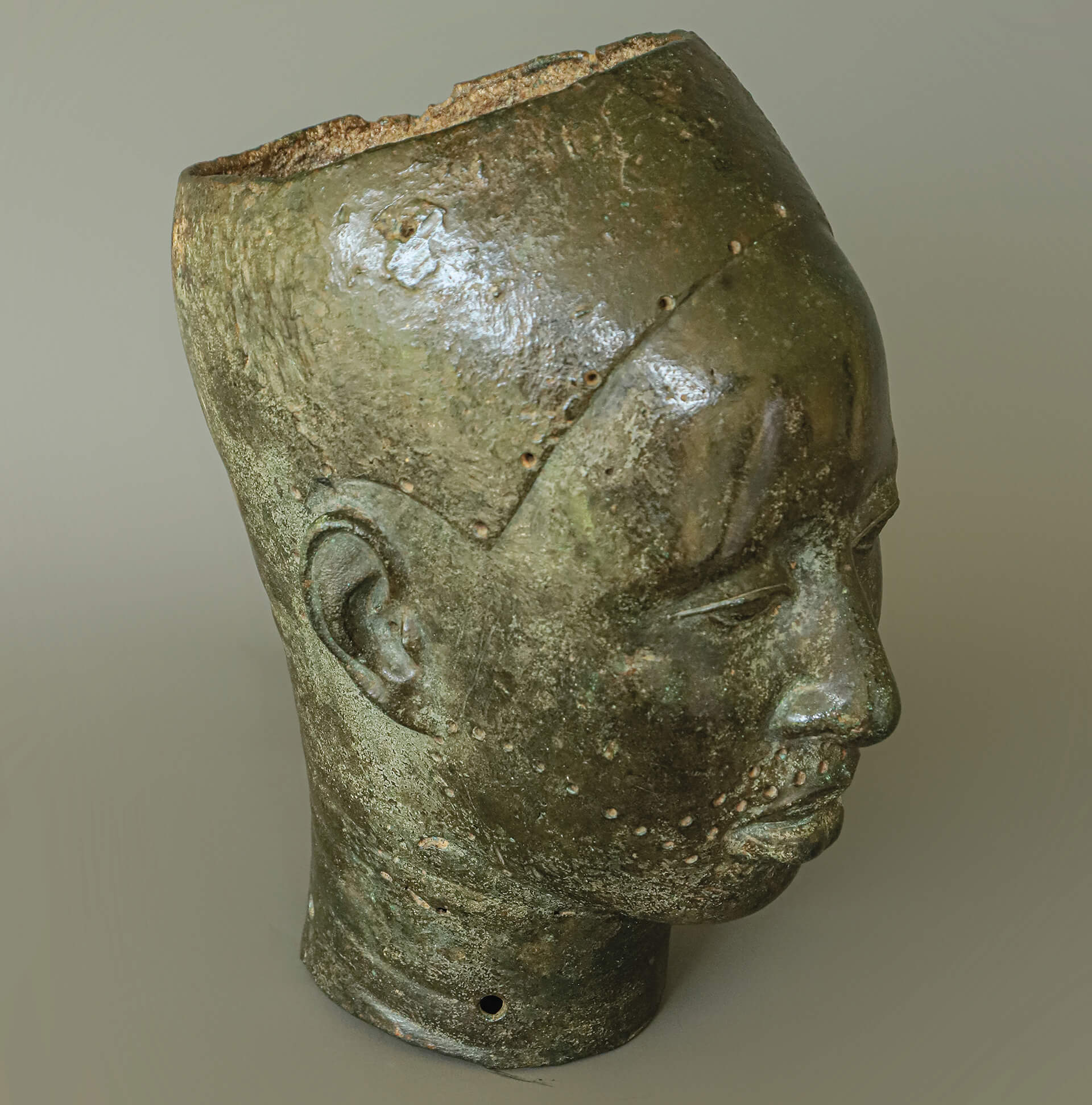
Ifè Bronze Memorial Head — 12 AD

Ifè Bronze Memorial Head — 12 AD

The Lost-Wax Casting Technique Explained

Ifè Bronze Memorial Head — 12 AD

Ifè Bronze Memorial Head — 12 AD

The cire perdue (French for “lost-wax”) technique is an intricate, multi-stage process for casting metal objects. It begins with creating a clay core shaped like the final metal piece. Artisans then apply a layer of beeswax, which forms the object’s detailed model. Bone, wood, or ivory tools are used to carve intricate patterns into the wax. Next, they cover the wax model with several layers of clay paste, known as the investment mould, which will eventually hold the shape. After it dries, the mould is heated until the wax melts and drains out, leaving a hollow cavity. Molten metal, usually bronze, brass, or copper alloys, is then poured into this space. Once the metal cools and hardens, the clay mould is broken open to reveal the finished metal object, which is then filed, polished, and sometimes given a chemical finish called a patina.

Consistency and Adaptation Across Regions

This technological standard achieved remarkable consistency over great distances and cultures. Yet, it permitted considerable artistic variation. The process required technical skill and a thorough understanding of materials science. Metalworkers had to consider shrinkage, melting points, and metal flow. The uniformity across regions is notable. It indicates either widespread knowledge exchange or the independent development of similarly advanced solutions. Historian of technology Joseph Needham might have described this as “convergent technological evolution” (Needham, 1954).

Ife: Royal Archives and Technical Mastery

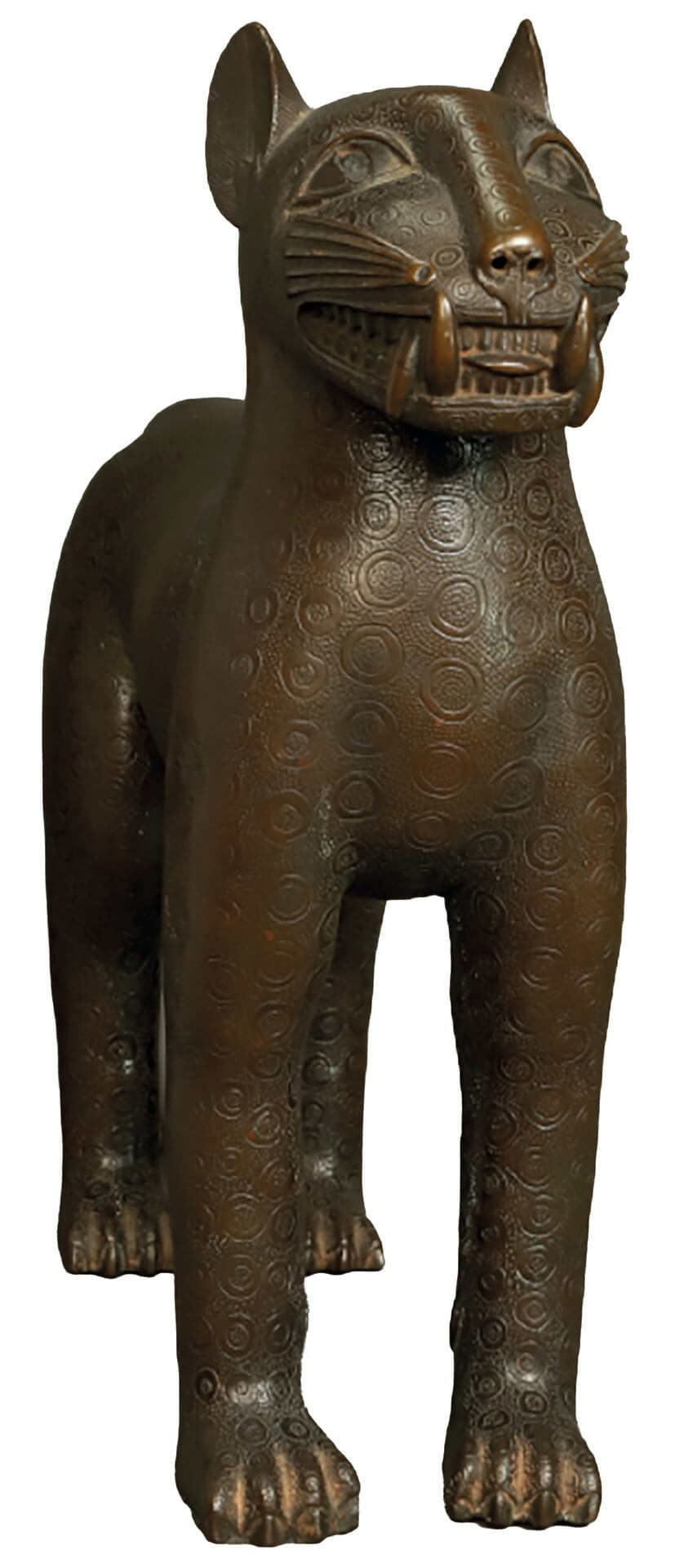
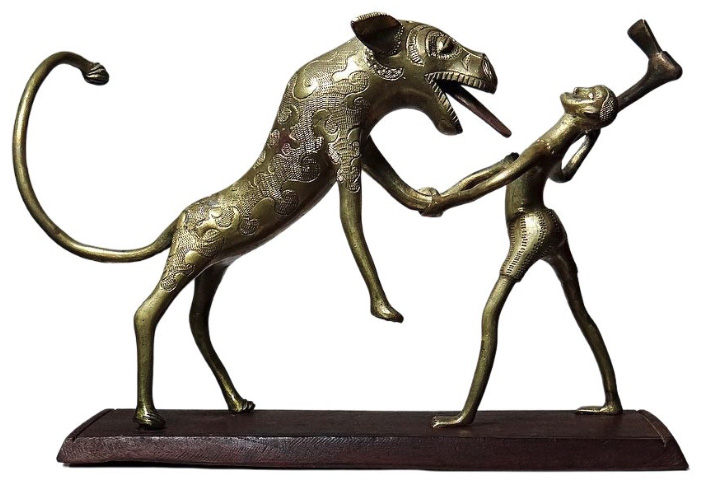
Benin Bronze Leopard — 16th Century

Benin Bronze Leopard — 16th Century

The centres of this revolution in Nigeria highlight the technical skill and cultural importance of lost-wax casting in great detail. Ife’s realistic bronze and copper alloy sculptures were made between the 12th and 15th centuries. They functioned as royal archives, preserving the likenesses of rulers and other prominent figures. These sculptures served as three-dimensional records, visually documenting leadership and succession in a society without written archives.

The remarkable precision of these castings is notable, especially since they were achieved without modern measuring or temperature controls.

Archaeological evidence suggests that Ife’s metalworkers developed advanced furnace technology capable of reaching the heat needed for bronze casting. They likely used bellows made from animal skins and clay tuyères to control airflow and temperature. The chemical composition of Ife bronzes shows consistent alloy proportions, indicating standardised preparation and quality control. This consistency suggests established workshop practices and structured systems for knowledge transfer.

Benin: Visual Databases and Statecraft

In the Kingdom of Benin, the lost-wax technique was the main method for documenting history and managing the state. The renowned bronze plaques that decorated the royal palace created a detailed visual record. These plaques documented court protocols, military campaigns, and diplomatic relations. According to historian Paula Ben-Amos, “these metal archives served functions comparable to modern national archives, preserving essential information about statecraft and governance” (Ben-Amos). The arrangement of these plaques indicates advanced principles of information management.

Benin’s bronzecasters guild, the Igun Eronmwon, developed a complex system of knowledge management and archival preservation. The guild maintained a living archive (an ongoing, actively updated body of knowledge) of technical information, historical facts, and artistic conventions. A hereditary apprenticeship system, where skills are passed down within families from one generation to the next, ensured the continuous preservation and updating of this knowledge base. This system worked similarly to modern digital backup systems for cultural information.

Igbo-Ukwu: Encrypted Digital Archives

The archaeological discoveries at Igbo-Ukwu in southeastern Nigeria uncovered a distinctive method involving lost-wax casting. Complex vessels and staffs discovered in burial contexts probably served as ritual archives. They held information about spiritual beliefs, cosmological ideas, and ceremonial practices. Unlike the public historical archives of Benin, these objects preserved esoteric knowledge for specialised religious practitioners. They operated much like encrypted digital archives with limited access.

Lower Niger Basin: Stylised Naturalism

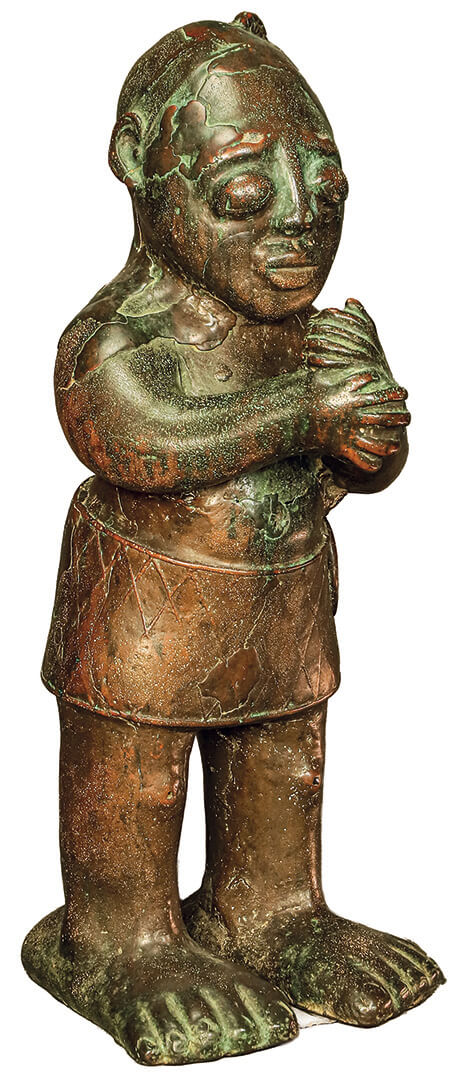
Bronze Figure from the Tada Corpus (Lower Niger Tradition)

Bronze Figure from the Tada Corpus (Lower Niger Tradition)

Extending this narrative westward, the metalworking traditions of the Lower Niger Basin form a distinct node within this technological network. This region encompasses the Niger Delta and its hinterlands. It produced bronze and brass artefacts that differ stylistically from those of Ife and Benin but share the same technical standards. Works from Jebba, Tada, and the Benin River area display a stylised naturalism. They often feature elaborate scarification patterns and complex iconography. Art historian Philip M. Peek notes that these pieces “represent a distinct artistic vision within the shared technical framework of lost-wax casting, underscoring the adaptability of the medium to local cultural expressions” (Peek, 2008).

The iconic Tada figure is a life-sized copper-alloy sculpture, seated on a rock in the Niger River. It reflects this tradition. Its serene posture and detailed surface work show mastery of the lost-wax technique, comparable to that of the more renowned Ife heads. The presence of such refined works outside the main royal centres suggests that metallurgical skill was more common than previously thought. Archaeologist Kit W. Wesler argues that “the Lower Niger Bronze Industry represents a parallel tradition of exceptional skill, likely serving city-states and trading polities that flourished along the river networks” (Wesler, 2012). These objects probably functioned as archives, preserving community history, territorial claims, and the legitimisation of authority for the trading states controlling riverine commerce.

Beyond Nigeria

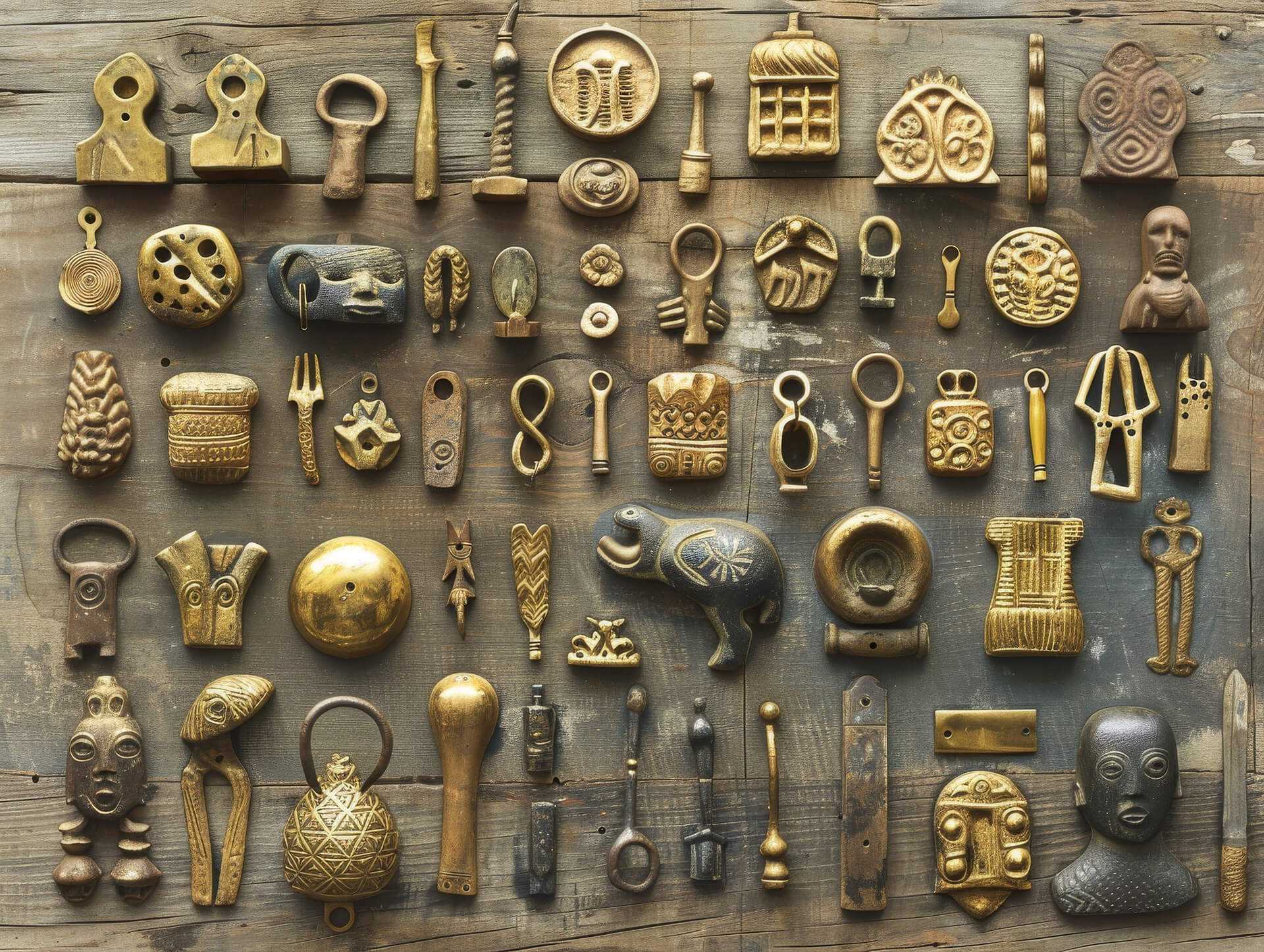
Akan Goldweights

Akan Goldweights

Lost-wax casting adopted various archival forms tailored to local needs. In contemporary Ghana, Akan goldweights served as educational archives, encoding proverbs, ethical principles, and practical knowledge. Each weight functioned as a memory device, preserving cultural information in a durable metal form. Scholar Emmanuel Akyeampong stated, “these miniature archives made essential knowledge portable and accessible for daily reference, much like modern mobile computing devices” (Akyeampong, 2001).

The systematic organisation of Akan goldweights into standardised weight categories established a classification system. Different types of knowledge were connected to weight units, forming a sophisticated retrieval framework. Physical objects prompted recall of related information. This system demonstrates an advanced understanding of information architecture and knowledge management principles.

Bronze Figurine originating from the Kingdom of Dahomey

Bronze Figurine originating from the Kingdom of Dahomey

In the Kingdom of Dahomey, lost-wax castings functioned as spiritual archives. They preserved information about Vodun cosmology and ritual practices. These objects encoded complex theological ideas and ceremonial protocols in a durable form. This preserved religious knowledge across generations. The accuracy of these representations was deemed essential to maintaining ritual efficacy. This created strong incentives to keep precise information.

The guild systems, that is, formal organisations of skilled artisans, developed around Lost-Wax casting across West Africa, serving as living archival institutions (institutions actively preserving and transmitting knowledge). These organisations preserved technical knowledge, historical information, artistic conventions, and cultural values. Their hierarchical structure, with masters (experienced artisans), journeymen (artisans who have completed training but are not yet masters), and apprentices (learners), created distributed knowledge storage systems. These systems had built-in redundancy, much like modern distributed databases, which store data across multiple locations for reliability.

Traditional Lost-Wax casting incorporates materials science knowledge, including an understanding of the properties of metals and other substances, as another form of archived information. Metalworkers learned about the properties of alloys (metals made by mixing two or more elements) through generations of experimentation. They preserved this knowledge through oral traditions (stories and teachings passed down by word of mouth) and practical demonstrations. This technical knowledge allowed continued production excellence over centuries.

Lost-Wax casting’s significance extends into modern information management. Encoding information in durable, three-dimensional formats anticipates data preservation techniques such as microfilm, digital storage, and blockchain. The distributed preservation methods of traditional guilds mirror today’s cloud storage and distributed databases.

Information Preservation

The philosophical method of information preservation seen in Lost-Wax casting provides valuable insights for modern digital preservation practices. Combining various preservation techniques, technical expertise, artistic traditions, and social institutions creates resilient systems for cultural continuity. This layered approach to safeguarding knowledge remains pertinent in an age of rapidly evolving digital storage technologies.

The environmental sustainability of traditional information preservation through metal objects provides another key lesson. Unlike digital storage, which demands ongoing energy and technological updates, metal archives passively safeguard information for centuries. This method of durable storage resonates with modern concerns about digital obsolescence and the environmental impact of continuous data centre operation.

Conclusion

In conclusion, the Lost-Wax revolution in West Africa, from the iconic centres of Ife and Benin to the prolific workshops of the Lower Niger Basin, exemplifies a sophisticated, decentralised system for preserving information and managing knowledge. These metal objects served as durable archives, preserving historical, cultural, and technical information across generations. The systems developed around their creation and maintenance demonstrate an advanced and widespread understanding of information architecture, knowledge preservation, and cultural continuity, with a truly continent-wide scope.

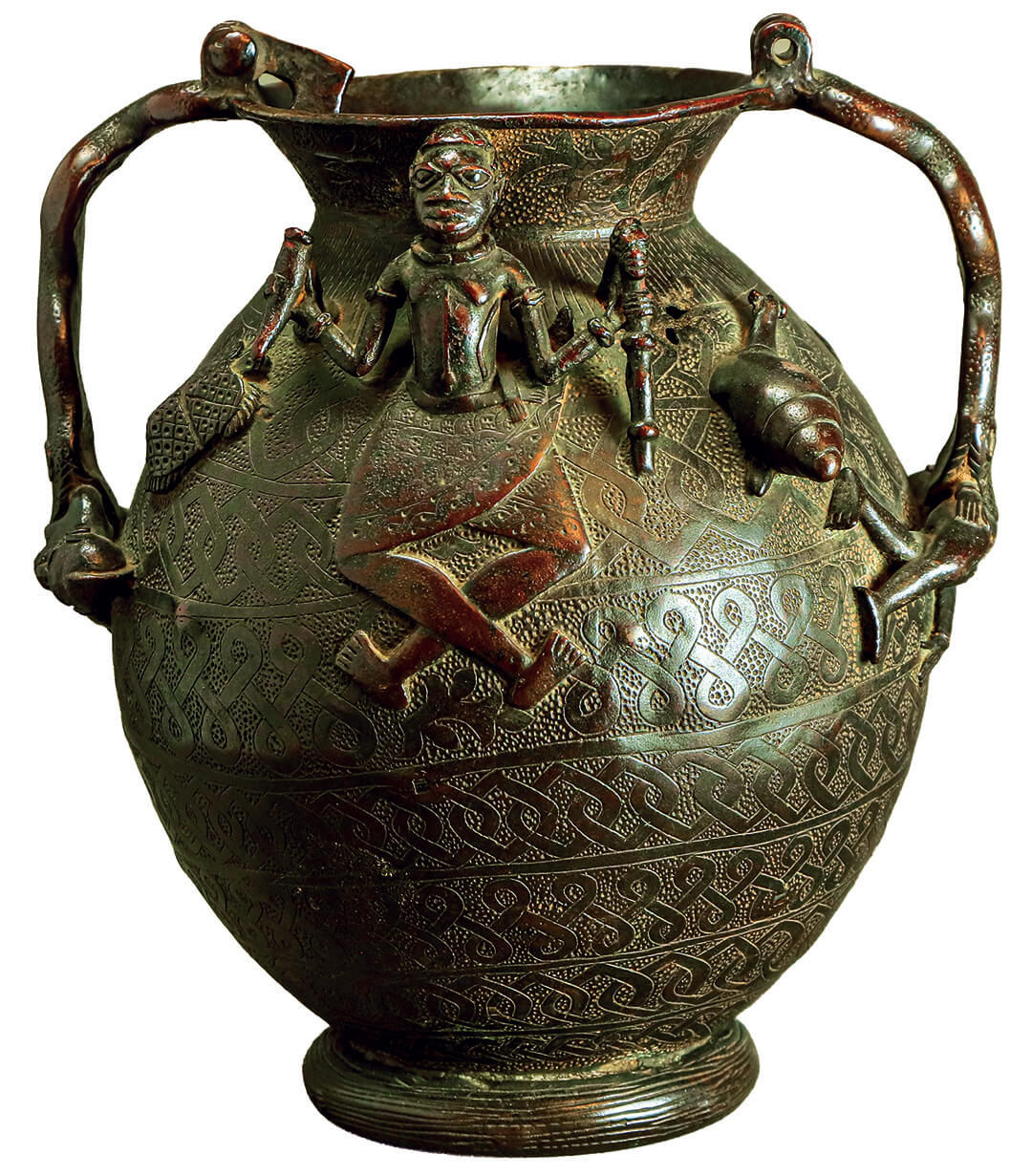
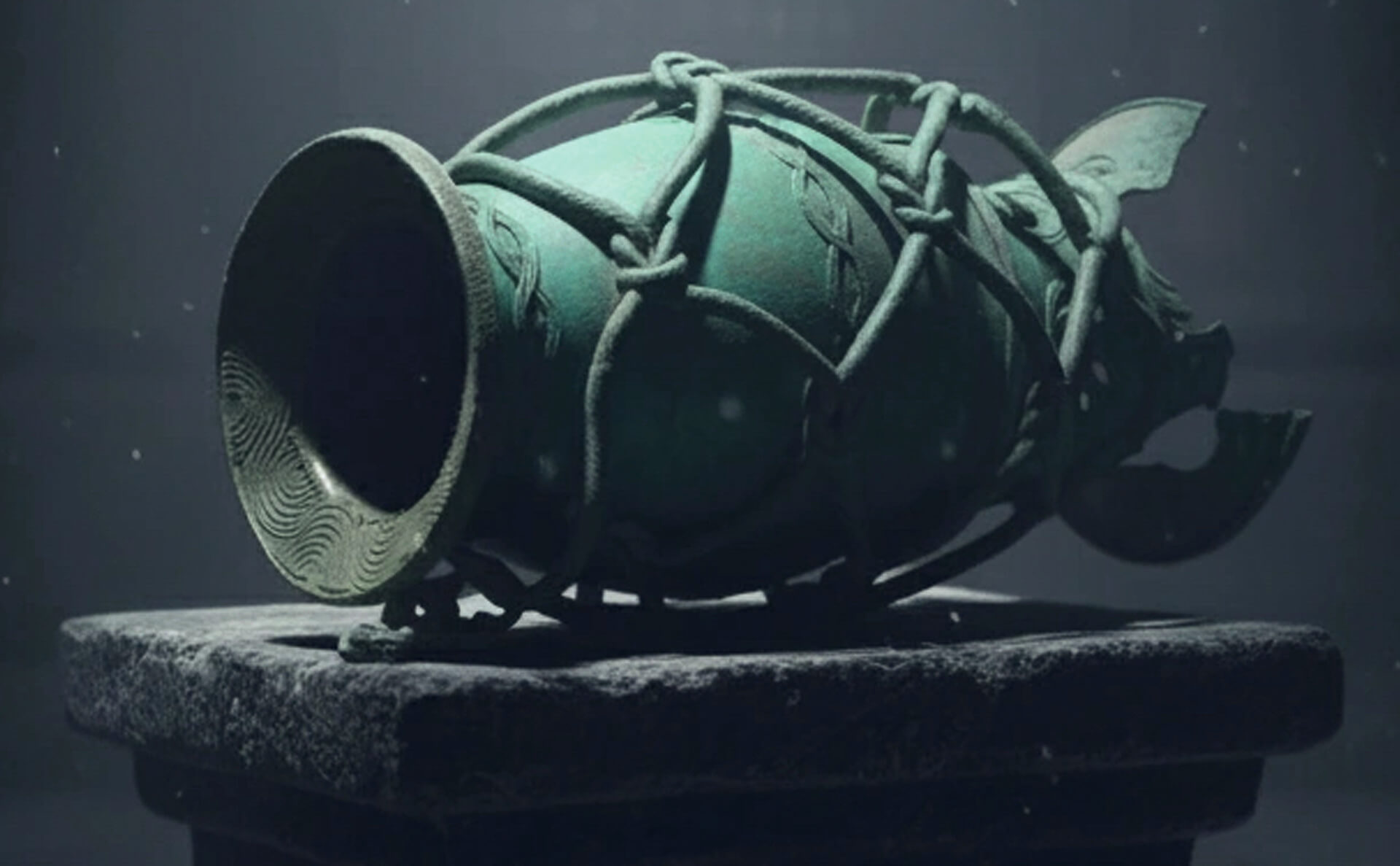
Benin Bronze Ritual Pot — 16th Century

Benin Bronze Ritual Pot — 16th Century

The significance of lost-wax casting extends beyond history. Today, its principles are evident in modern investment casting techniques used in aerospace and biomedical engineering, where the need for precision and complexity reflects the skills developed by West African artisans. In art, contemporary sculptors worldwide, such as Sokari Douglas Camp in the UK and El Anatsui in Ghana, continue to adapt and reinterpret lost-wax methods, recognising their roots while innovating for the present.

The integration of information preservation with artistic expression and technological innovation resulted in multifunctional objects that benefited their societies in various ways. This holistic approach to knowledge management provides valuable lessons for today’s information society, where specialisation often separates technical, artistic, and archival functions. The durability of these metal archives over centuries stands as a testament to their effectiveness as information preservation systems.

It is also crucial to consider why this technological tradition remained so resilient. The robust apprenticeship systems, the social prestige of the bronzecasters, and the deep integration of artistic, spiritual, and political life ensured that knowledge was not merely stored but lived, performed, and renewed. In pre-literate societies, these objects embodied memory and authority, functioning as living documents and active participants in community life. While scholars continue to debate the origins, spread, and cross-cultural influences of West African lost-wax casting, its distinctive role in shaping identity and power remains evident.

As we develop new technologies for digital preservation and knowledge management, the principles embedded in the Lost-Wax tradition remain profoundly relevant. The value of durable storage media, distributed knowledge systems, and the integration of information with cultural practice all offer important insights for addressing contemporary challenges of information preservation. This remarkable chapter in human technological development continues to inform our understanding of how societies can preserve essential knowledge across generations.

Looking ahead, as we face digital obsolescence and environmental issues related to data storage, the enduring nature of cast metal objects offers valuable lessons. The traditional lost-wax technique’s combination of durability, flexibility, and cultural significance serves as a model for harmonising innovation with sustainability in the digital era. We can also learn from how West African artisans embedded memory into objects that were both beautiful and functional, making information accessible, meaningful, and lasting.

References

Akyeampong, E. (2001). Between the Sea and the Lagoon: An Eco-social History of the Anlo of Southeastern Ghana. Ohio University Press.
Ben-Amos, P. (1999). Art, Innovation, and Politics in Eighteenth-Century Benin. Indiana University Press.
Blier, S. P. (2015). Art and Risk in Ancient Yoruba: Ife History, Power, and Identity, c. 1300. Cambridge University Press. Journal of Materials Processing Technology. (2021). Advanced Investment Casting Techniques for Complex Components. Elsevier Press.
Needham, J. (1954). Science and Civilisation in China. Cambridge University Press.
Peek, P. M. (2008). Step Style: Meaning and Change in African Art. African Arts, 41(2), 14-25.
Rush, D. (2013). Vodun in Coastal Benin: Unfinished, Enduring Stories. University of Washington Press.
Shaw, T. (1970). Igbo-Ukwu: An Account of Archaeological Discoveries in Eastern Nigeria. Faber & Faber.
Silverman, R. A. (1983). Akan Transformations: Problems in Ghanaian Art History. University of California Press.
Wesler, K. W. (2012). An Archaeology of West Africa’s Craft Landscapes. In J. C. Monroe & A. Ogundiran (Eds.), Power and Landscape in Atlantic West Africa (pp. 317-341). Cambridge University Press.
Willett, F. (1967). Ife in the History of West African Sculpture. Thames and Hudson.


Oriiz
Oriiz is a Griot, Curator, Designer, Culture Architect, and Strategist who makes African history portable and accessible to everyone: those who know, those who question, and those who never thought to ask. He connects 8,000 years of knowledge with the present. Oriiz also edited and served as Executive Producer for The Benin Monarchy: An Anthology of Benin History (The Benin Red Book), Wells Crimson, 2019. Author: The Harbinger: A Window into the Soul of A People: 8000 years of Art in Nigeria, Crimson Fusion (2025).
:::::::: oriiz@orature.africa IG: @oriizonuwaje
The Walls of the Great Benin Kingdom:
A Civil Engineering Wonder

Oriiz explores the often overlooked achievements of pre-colonial African societies, highlighting the monumental legacy of the Walls of Benin and other engineering marvels.

For centuries, the dominant narrative of human civilisation has been disproportionately shaped by a selective historical perspective. This view has often marginalised and overlooked the remarkable achievements of pre-colonial African societies. The continent was frequently portrayed as a passive receiver of culture and technology, rather than what it truly was: a vibrant and dynamic birthplace of empires whose architectural, administrative, and engineering prowess not only rivalled but often surpassed that of their contemporaries across the globe (Connah, 2001).

Download PDF version of Essay
These societies left behind a legacy carved not on fragile parchment but built directly into the earth itself. This was a proof designed to endure for millennia. Among these lasting wonders, the extensive earthworks of the Benin Kingdom stand as an exceptional, and arguably unmatched, monument to human ingenuity. This enormous feat of civil engineering is so vast in its design and realisation that it fundamentally shifts our understanding of pre-modern urban planning, state power, and African intellectual achievement. Modern analysis recognises the Benin earthworks as “the largest earthwork in the world” prior to the mechanical age (ThinkAfrica).

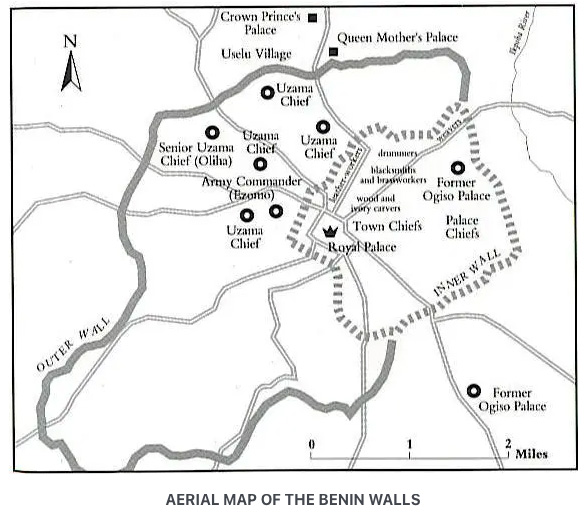
Aerial Map of the Benin Walls

Initiated by the Edo people as early as 800 AD and developed over many centuries, the Walls of Benin stand as one of the most impressive and enduring architectural feats in human history (Bondarenko & Roese, 1999). To simply call them “walls” is a considerable understatement that does not do justice to their complexity. In reality, they were a sophisticated, fully integrated system of tall ramparts and deep, strategically placed moats, arranged in concentric rings extending from the sacred core of the royal palace. This was not a haphazard or primitive fortification; it was a clear expression of advanced urban planning, hydraulic engineering, and meticulous defensive strategy. The city’s layout was embedded in this structure, guiding movement, function, and social hierarchy.

The innermost rings were designated to protect the Oba’s palace, the spiritual, political, and administrative heart of the kingdom, along with the noble residencies. These central areas were fortified with legendary defences, the secrets of which are still studied today.

Archival materials and recent analysis show that these internal walls were constructed using a unique composite material: local earth carefully mixed with palm oil. This clever formula triggered a chemical reaction during drying that transformed the mixture, hardening the walls to a consistency similar to concrete. The result was “a near cement-like consistency as well as resilience” that proved notably resistant to both tropical erosion and European cannon fire (ThinkAfrica).

This was far more than simple mud and straw. It was a deliberately engineered chemical solution designed for maximum defensive utility and durability, demonstrating a deep, sophisticated understanding of local material properties. This is a hallmark of advanced engineering.

Nonetheless, this clever local solution was only the impressive core of a much larger, almost unfathomable whole.

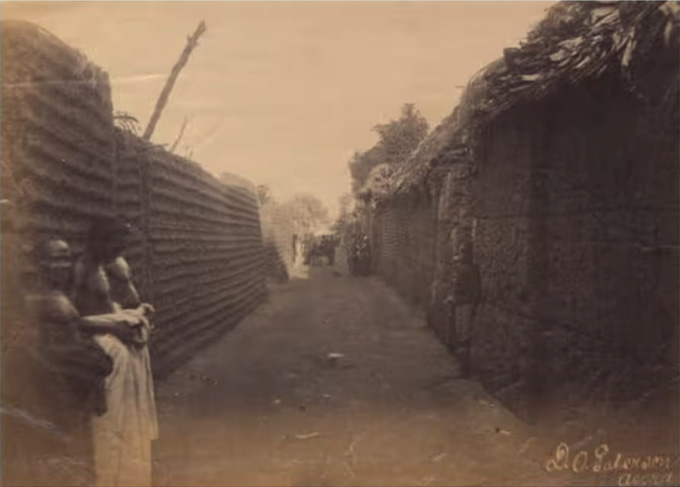
A Street Scene with Earthwork Structures in the Kingdom of Benin,
possibly captured in February 1891.

A Street Scene with Earthwork Structures in the Kingdom of Benin,
possibly captured in February 1891.

The extensive network of outer walls and ditches remains one of the largest archaeological phenomena on the planet. The effort needed to build it involved moving an estimated ‘100 million hours more earth than the Great Pyramid of Giza,’ a figure that emphasises the colossal scale of the coordinated labour involved (ThinkAfrica).

The entire system extended for about 16,000 kilometres, winding through dense forests and open plains to enclose a vast area exceeding 6,500 square kilometres. This territory is larger than many modern European countries (Bondarenko & Roese, 1999). To understand this scale, the length of the earthworks is comparable to the distance from New York to Buenos Aires. Some of the outer ramparts rose over 60 feet tall and were backed by deep, formidable ditches.

These structures served many purposes beyond simple defence. They acted as an advanced system for managing trade and movement, collecting taxes on goods entering the kingdom’s territory.

They also constructed an extensive drainage network, skillfully directing heavy tropical rains away from inhabited areas. Most importantly, they served as an unalterable, tangible symbol of the kingdom’s authority, permanence, and divine order. They were the kingdom’s infrastructure, its economic regulator, its territorial boundary, and its royal banner, all seamlessly integrated into a single, colossal earthwork that defined the Benin worldview.

Importantly, this display of engineering brilliance was not a one-off accomplishment but part of a broad regional phenomenon.

To the west, the Yoruba people of the Ijebu Kingdom built the massive Sungbo’s Eredo around the 10th century. This single, continuous 100-mile-long rampart and ditch enclosed an entire kingdom, demonstrating a comparable mastery of logistics, surveying, and communal effort (Usman, 2001).

Its construction probably involved an intricate system of labour organisation, possibly based on lineage or guild contributions, mobilising a large workforce for a communal project that defined sovereign territory and protected prosperous settlements. The simultaneous existence of Benin’s walls and Sungbo’s Eredo fully dispels any lingering myth of isolated, simple societies. These were complex, highly organised polities capable of large-scale, sophisticated territorial sculpture and landscape engineering.

Benin Moat and Rampart Today

Benin Moat and Rampart Today

A Pan-African Tradition of Monumental Innovation

This tradition of monumental innovation embodies a significant yet often overlooked pan-African thread, linking diverse cultures across the continent and highlighting a shared, intrinsic drive for technological and artistic achievement that is crucial to “reshaping historical perspectives” on Africa’s past (ThinkAfrica).

Far to the south, the stone ruins of Great Zimbabwe (c. 1100-1450 AD) showcase a different but equally remarkable talent for material mastery. Here, the Shona civilisation displayed their skill not with earth, but with stone.

Shona engineers and stonemasons built elaborate, freestanding walls using precisely cut granite blocks, all fitted together with remarkable, gravity-defying accuracy and without mortar. This technique demonstrates exceptional skill and geometric understanding (The British Museum, n.d.).

The Great Enclosure, with its famous conical tower and sweeping, curving walls over 30 feet tall, stands as a clear masterpiece of aesthetic design and practical engineering. This city was much more than a village; it acted as the ceremonial and economic centre of a powerful empire that controlled the flow of gold, ivory, and other goods from the interior to the Indian Ocean coast, placing it at the centre of a vast global trade network (Pikirayi, 2001).

The city’s layout, which distinctly separated the ruler’s Hill Complex, with its religious and ceremonial functions, from the citizens’ Valley Complex below, demonstrates a sophisticated understanding of social organisation, administrative control, and a desire to harmonise with the natural environment.

In the Senegambia region, the Sereer people demonstrated their architectural expertise in a unique and equally impressive manner: through the Tumuli of Cekeen. This area, containing over 12,000 man-made burial mounds, represents a remarkable achievement in both spiritual expression and civil engineering.

Constructing these enduring, monumental hills demanded extensive coordinated labour, precise soil-compaction techniques, and expert project management to ensure their durability against the elements for centuries. They served as sacred tombs for royalty and nobility, with their size and prominence directly reflecting the status, wealth, and legacy of the buried individual.

Evidence suggests that some mounds are astronomically aligned, demonstrating an advanced understanding of astronomy and a strong desire to connect earth’s power with the celestial sky (Holl, 2006).

The collective effort needed to build these structures clearly shows a highly organised society, characterised by complex religious beliefs, a well-defined social hierarchy, and a skilled class of artisan-engineers capable of creating timeless, sacred designs.

Shared Principles: The Pillars of Advanced Society

The close link between these geographically distant sites lies in their shared, sophisticated use of three core principles: civil engineering, urban planning, and symbolic architecture. None of these structures was random or simple; each was created through careful, deliberate planning, designed to utilise the landscape to serve human needs, spiritual beliefs, and a lasting social order.

Civil Engineering formed the fundamental basis of these achievements. The builders possessed a deep, practical understanding of their materials and the laws of physics.

In Benin, they built ramparts to withstand erosion and pioneered a palm-oil composite for defence. This innovation directly “reveals the ingenuity of local material use” (ThinkAfrica).

In Zimbabwe, they mastered the complex art of dry-stone walling, ensuring structural stability, durability, and proper drainage without the use of binders. At the Tumuli, they developed sophisticated large-scale earthworking techniques and a nuanced understanding of soil mechanics.

Each of these projects demanded advanced skills in surveying, logistics, water management, and the administration of large, coordinated workforces. All of these are essential, defining pillars of civil engineering that stand against any idea of technological stagnation.

Urban planning was another crucial element, demonstrating that these were well-organised administrative states. These impressive structures formed the centre of structured city life and territorial control.

In Benin, the concentric rings clearly marked specific zones for administration, specialised craft production, trade, and residential areas. This established a framework that supported good governance, economic activity, and social hierarchy. The walls functioned as a comprehensive system for “drainage, trade regulation, and territorial demarcation” (ThinkAfrica), showing they were as essential for managing a busy, complex city as for defending it.

At Great Zimbabwe, the distinct separation of the royal, ceremonial, and commoner complexes illustrates a sophisticated ideology of how society should be organised, governed, and spatially arranged for both practical and symbolic purposes.

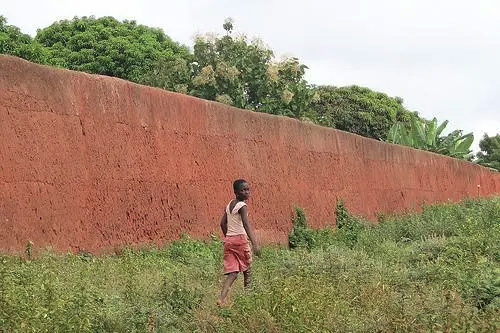
A remaining section of the Great Walls of Benin,
a massive network of earthworks in Edo State, Nigeria.

A remaining section of the Great Walls of Benin,
a massive network of earthworks in Edo State, Nigeria.

Finally, Symbolic Architecture was the powerful, unseen layer that granted these structures their enduring significance. At their core, they embodied expressions of political and spiritual power displayed on a monumental scale.

The enormous, awe-inspiring scale of the Benin Walls stood as a constant physical symbol of the Oba’s divine authority and the kingdom’s undefeated strength. The fortified, impregnable palace walls conveyed a dual message of technological superiority and resilience against potential enemies.

Similarly, the vast, unmortared stone walls of Great Zimbabwe served as unshakeable symbols of the state’s legitimacy, wealth, and permanence. These were meant to evoke the same awe and respect as the great monuments of Egypt or medieval Europe. The Tumuli of Cekeen, in turn, linked earthly rule to the ancestors and the cosmic order, anchoring secular power in spiritual legitimacy and the eternal cycle of life.

In every instance, the aim was to inspire admiration and uphold the social order, a purpose equally vital as any practical role.

Legacy and Conclusion

The great empires of pre-colonial Africa did not simply exist; they left a profound legacy of power, ingenuity, and mastery across the continent. This history is etched in earth and stone, warranting recognition not as a marginal note but as a central monument in our shared human history.

By embracing the true, astonishing scale of these achievements — such as the sobering fact that the Walls of Benin required moving a volume of earth that significantly “surpassed that of the Great Pyramid of Giza” (ThinkAfrica) — we do more than amend an outdated historical record. We actively reveal a profound and empowering legacy of African innovation in “civil engineering, urban planning, and symbolic architecture” (ThinkAfrica).

This legacy is hardly just a remnant of the past. It serves as a powerful testament to human potential, challenging enduring stereotypes and offering a profound source of pride and inspiration. It commands respect for the intellectual history of the African continent and acts as a driving force for innovation, demonstrating that principles such as large-scale project management, sustainable material use, and visionary urban design are well-established and can propel progress for generations to come. Recognising these marvels is essential for developing a truly complete and honest understanding of our shared global heritage.

Works Cited

  1. Bondarenko, D. M., & Roese, P. M. (1999). *Benin Precolonial Urbanism: A Summary of the Archeological Evidence.*
  2. Connah, G. (2001). *African Civilizations: An Archaeological Perspective* (2nd ed.). Cambridge University Press.
  3. Holl, A. F. C. (2006). *West African Early Towns: Archaeology of Households in Urban Landscapes.* Ann Arbor: Museum of Anthropology, University of Michigan.
  4. Pikirayi, I. (2001). *The Zimbabwe Culture: Origins and Decline of Southern Zambezian States.* AltaMira Press.
  5. ThinkAfrica. (n.d.). “The Walls of the Great Benin Kingdom: A Civil Engineering Wonder.” *ThinkAfrica*. https://thinkafrica.net/walls-of-benin/. Accessed 6 March 2026.
  6. The British Museum. (n.d.). “Great Zimbabwe.” The British Museum. https://www.britishmuseum.org/collection/galleries/great-zimbabwe.
  7. Usman, A. A. (2001). *The Yoruba Frontier: A Regional Perspective on Ijebu and Its Neighbours.* (Example stand-in for a source on Sungbo’s Eredo).

Oriiz
Oriiz is a Griot, Curator, Designer, Culture Architect, and Strategist who makes African history portable and accessible to everyone: those who know, those who question, and those who never thought to ask. He connects 8,000 years of knowledge with the present. Oriiz also edited and served as Executive Producer for The Benin Monarchy: An Anthology of Benin History (The Benin Red Book), Wells Crimson, 2019. Author: The Harbinger: A Window into the Soul of A People: 8000 years of Art in Nigeria, Crimson Fusion (2025).
:::::::: oriiz@orature.africa IG: @oriizonuwaje
Igbo Ukwu Bronzes and Fine Watches:
The Intersecting Worlds of Ancient Art and Modern Engineering

By Oriiz U Onuwaje

Oriiz explores the link between the 9th-century bronze craftsmanship of Igbo Ukwu and the precise engineering of modern Swiss watchmaking. He believes that, despite being more than a thousand years apart, both traditions are rooted in a shared dedication to blending art with technical skill.

Both the ancient Nigerian metalsmith and the contemporary watchmaker demonstrate that real genius lies in the thorough pursuit of perfection, where every detail, even those hidden from view, is executed with integrity, patience, and deep respect for the materials.

This comparison shows that the desire to create beautiful, lasting objects is a timeless, universal part of being human.

Download PDF version of Essay

The Everlasting Impulse to Create

We often describe human history as a steady progression from simple tools to advanced technology. Yet this view can obscure a deeper truth: throughout time and across cultures, people have reached remarkable heights of creativity and skill that stand on their own. This essay examines two such achievements, which seem very different, to uncover the common spirit behind them.

At first, these two worlds seem completely different. One is about ancient bronze objects found in Nigeria from the ninth century. The other is about watches, filled with tiny gears and springs.

But if we see the Igbo Ukwu vessels and Swiss watches only as products of their own times, we miss something important. Even though they are more than a thousand years apart, both show how human skill can bring together art and engineering.

These objects reflect our shared desire to shape raw materials and solve technical problems to create beauty, meaning, and precision. The following analysis examines the long gap between them to identify the ideas that connect a ninth-century Nigerian metalsmith and a modern Swiss watchmaker.

It suggests that combining artistic vision with technical skill is a lasting part of human creativity.

Igbo Ukwu: The Ninth-Century Precision Revolution

The story of Igbo Ukwu starts not in a palace, but at a well. In 1939, Isaiah Anozie was digging on his land in southeastern Nigeria when he found metal. His discovery changed the history of West African art. Later, archaeologists found a collection of objects: decorated bronze altar stands, carefully made rope pots, detailed pendants, and ceremonial vessels showing great skill.

Igboukwu Soft Blend

9th Century Igbo Ukwu Bronze Bowl with waisted cylindrical form; rope-like and geometric patterns; perforations on body.
(Location: National Museum, Onikan – Lagos)

At first glance, these objects inspire awe. Their designs are complex and full of meaning. Sculpted flies and beetles move across the surfaces, serpents twist, and human figures sit in important poses. The surfaces are covered with textures, tiny dots, patterns like wires, and circles and spirals that seem full of life. This was more than decoration; it was a visual language that showed the beliefs and social order of a people whose name we do not know.

But what is most remarkable is the engineering behind these objects. They were made using the lost-wax casting method, a process so advanced that it was among the best in the world at the time.

The process develops in a series of precise, engineering-like steps:

  1. Design and Prototyping (The Art): An artisan would first sculpt the entire object, including every minute detail and every textural pattern, in beeswax.
  2. Mould Engineering (The Engineering): The artisan carefully encased the wax model in a thick clay-based mould. They finely crafted and added channels (sprues) to allow air to escape and molten metal to flow in.
  3. The Kiln Phase (Materials Science): The entire mould was fired in a kiln. This was a key phase in which engineering intuition was vital. The heat had to be precisely controlled to melt and drain the wax completely, leaving a hollow cavity without cracking the clay mould.
  4. Metallurgy and Pouring (Applied Physics): A precise copper alloy (often a leaded bronze) was smelted to a precise temperature. The molten metal was then poured into the preheated mould, filling the elaborate cavity left by the wax.
  5. The Reveal (The Final Test): After the object had cooled, the artisan broke away the clay mould to reveal the solid bronze form within.

The skill shown at Igbo Ukwu was careful and exact. Artisans made large vessels with thin, even walls, which meant they had to control the metal and heat very precisely. Even more impressive was their attention to tiny details. They carved small dots, fine lines, and tiny spirals by hand into wax models. This level of care and patience is similar to what we see in modern micro-engineering or expert engraving.

They did all this without magnifying lenses or modern tools, relying only on their skill, steady hands, and a clear idea of the design. In their work, engineering and art were one and the same, with each technical step shaped by artistic vision.

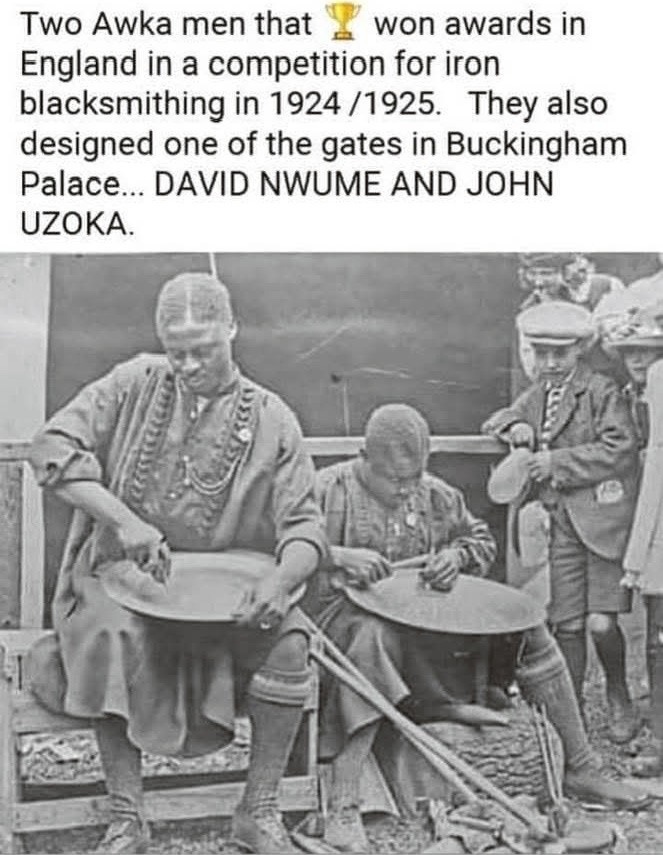
The Living Legacy: Awka Blacksmiths on the World Stage

Awka Blacksmiths on the World Stage

The story of Igbo metallurgy does not stop with the Igbo Ukwu masters. It continued vibrantly into the modern era. Ancient knowledge was preserved and refined by blacksmith guilds across Igboland, especially in Awka, a city long recognised as a centre of metallurgical excellence. This living legacy reached the world stage in the 1920s, when two Awka blacksmiths, David Nwume and John Uzoka, travelled to England. They won honours in a national ironwork competition in 1924/25 and were commissioned to design a gate at Buckingham Palace.

Their success is an important part of world history. It proves that the skills seen at Igbo Ukwu were not just a one-time event, but part of a living tradition. The fact that two Igbo smiths won top awards in Britain and worked for the Crown shows their mastery was still world-class, even after a thousand years. They brought their ancestors’ talent into modern ironwork, connecting the past to the present and demonstrating that this tradition of excellence endures.

Fine Watchmaking: The Modern Heir to an Ancient Principle

If Igbo Ukwu shows the height of ancient metalworking, then the fine mechanical watch is its modern counterpart. While a watch tells time, for collectors and makers, it is really a showcase of human skill and craftsmanship. This idea is similar to the purpose of the sacred objects from Igbo Ukwu. You can see the skill in a fine watch right away. Guilloché patterns, made by hand on special machines, make the dial shine with a precise beauty. The elegant numbers, shaped hands, and polished edges all add to its charm. A fine watch is, in many ways, a piece of art you can wear. But beneath the surface is the heart of the watch: its movement, or calibre. This is where engineering is most important. A single watch can have hundreds of tiny parts such as gears, springs, levers, and jewels, all working together. The challenges faced here are similar to those the Igbo Ukwu masters dealt with in their own work.

Miniaturisation and Precision: Watchmakers work at millimetre and micron scales. A gear train must be manufactured to tolerances finer than a human hair to assure precision. This is the direct descendant of Igbo Ukwu micro-engineering.

watch

Materials Science: Modern horology relies on advanced metallurgy. Alloys such as Glucydur for balance wheels, silicon for hairsprings, and proprietary materials are engineered to be non-magnetic, temperature-resistant, and perfectly elastic. This represents the evolution of the Igbo-Ukwu smith›s natural understanding of bronze›s properties.

Complexity of Assembly: Assembling a grand complication watch, with features such as a perpetual calendar, chronograph, and minute repeater, can take months. It requires an understanding of how hundreds of parts interact as a system, a mechanical ecosystem as delicate and interdependent as any natural one.

48 Vacheron Constantin WW 2025

The Vacheron Constantin Traditionnelle Complete Calendar Openface watch (first introduced in December 2021).

Finishing and decoration are the clearest artistic connections to Igbo Ukwu. Techniques like Geneva stripes, circular graining, and angle polishing are more than just decoration. They show respect for the craft and prove that the hours of handwork spent on every part, even those that cannot be seen, are perfect. This is similar to the Igbo Ukwu artisan, who added fine details throughout, knowing they were important to the object’s sacred value.

Brands such as Patek Philippe, A. Lange & Söhne, and Vacheron Constantin do not just sell watches. After all, smartphones keep better time. Instead, they offer a tradition in which art and engineering go hand in hand, each making the other better, to create objects that last.

The Intersection: Where Two Worlds Converge

Even though they are separated by time and culture, the Igbo Ukwu artisan and the Swiss watchmaker
share many important ideas. Their work comes together around several key principles:

  1. Mastery of Process: In both traditions, the process is just as important as the result. Lost-wax casting and assembling a watch movement are long, difficult, and risky tasks. Real mastery shows not only in the final product but in doing each step perfectly. This is practical knowledge gained through experience, a true skill.
  2. Obsession with Hidden Detail: Both traditions strive for perfection, even in places no one will see. The Igbo Ukwu artist decorated the bottoms of pots and the insides of vessels. The watchmaker finishes parts hidden inside the watch. For both, true integrity means making every part beautiful and well-crafted, as a promise between the maker and the object.

This reverence for hidden perfection speaks to a shared ethical and aesthetic philosophy: that integrity in craftsmanship entails excellence in every aspect, seen or unseen. For the Igbo Ukwu artisan, this might have reflected spiritual respect for the object’s purpose. For the watchmaker, it honours a tradition in which every component, no matter how small or concealed, must meet the highest standard. In both cases, the unseen effort becomes a silent testament to the maker’s honour and skill.

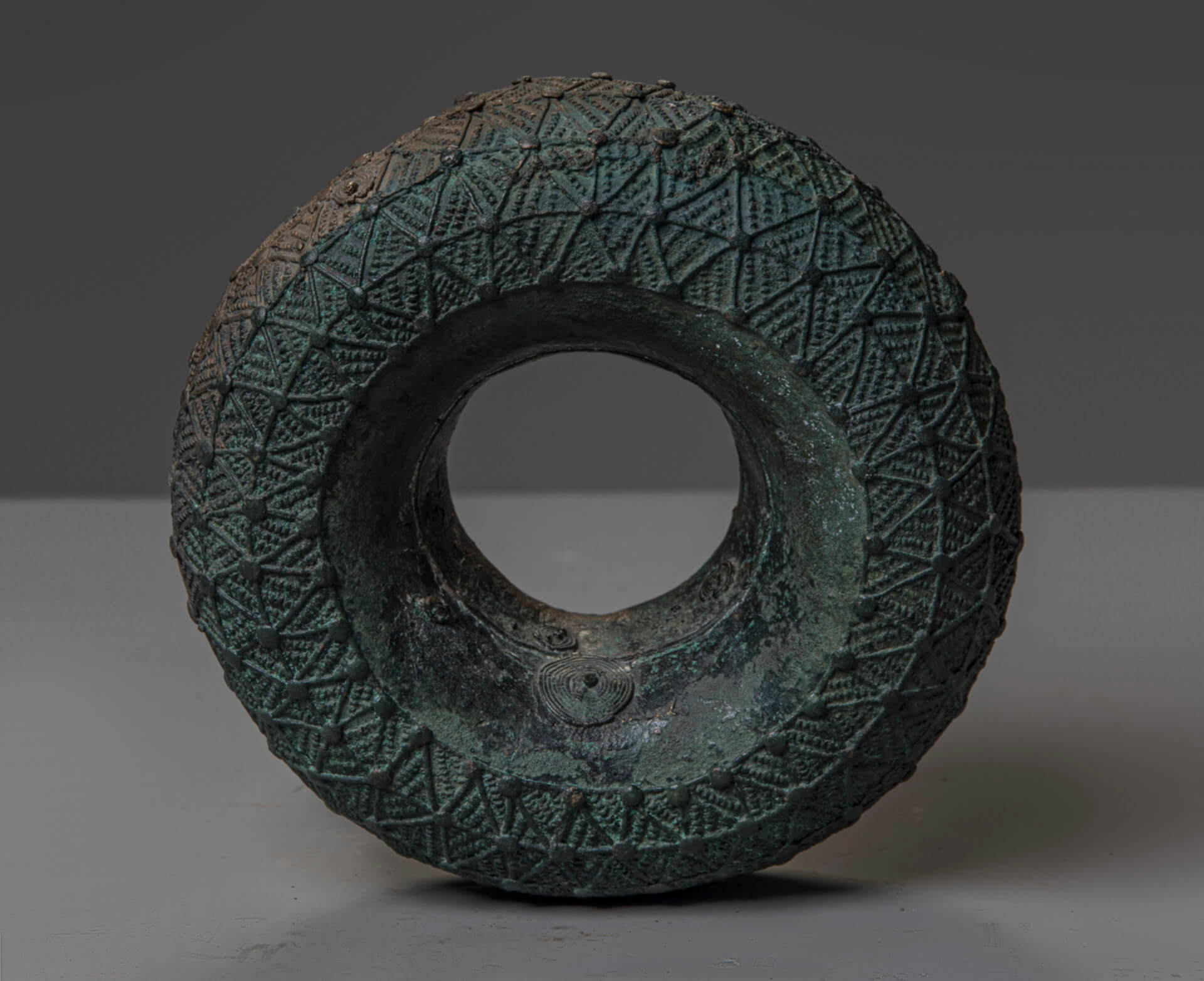
Roundy

9th Century Igbo Ukwu Bronze Torus, copper alloy with intricate geometric patterns and high level of detail.
(Location: National Museum, Onikan – Lagos)

  1. Form and Function United: In both traditions, beauty and usefulness go hand in hand. The shape of an Igbo Ukwu pot is both ceremonial and beautiful. The design of a watch movement is mechanical yet balanced and pleasing. If you separate beauty from function, you lose something important.
  2. Making Objects to Last: These items were made to endure. Igbo Ukwu bronzes were created for sacred use and intended to last for centuries, connecting people to the divine and signifying a leader’s status. A fine watch is made to be passed down as an heirloom, carrying memories and a legacy. Both are built to last in a changing world, choosing timelessness over things that fade quickly.

A Universal Human Language

The journey from Nigeria’s ninth-century bronze makers to today’s Swiss watchmakers is not merely a story of progress. It shows that human excellence is a lasting and shared trait. The Igbo Ukwu objects remind us that the desire to create things of great skill and beauty is neither new nor limited to one culture. They were not “ahead of their time”; they were the best of their time, shaped by their own culture, beliefs, and knowledge. The same applies to the watchmakers in the Vallée de Joux.

When we compare these two traditions, we do not diminish either; we honour both. Art and engineering do not merely meet; together, they create a rich space where human talent shines. The Igbo Ukwu master and the Swiss watchmaker, though a thousand years apart, share the same values: patience, precision, and deep respect for materials. They show us that true craftsmanship is a form of wisdom, and that a well-made object, whether a bronze vessel or a watch, is proof of the enduring human spirit.


Oriiz
Oriiz is a Griot, Curator, Designer, Culture Architect, and Strategist who makes African history portable and accessible to everyone: those who know, those who question, and those who never thought to ask. He connects 8,000 years of knowledge with the present. Oriiz also edited and served as Executive Producer for The Benin Monarchy: An Anthology of Benin History (The Benin Red Book), Wells Crimson, 2019. Author: The Harbinger: A Window into the Soul of A People: 8000 years of Art in Nigeria, Crimson Fusion (2025).
:::::::: oriiz@orature.africa IG: @oriizonuwaje

Our Weaver’s Beam and Algorithms:
Decoding the Digital Logic of Aso Oke, Akwete and Kente

By Oriiz U Onuwaje

Oriiz examines how the logic behind Aso Oke, Akwete, and Kente weaving shapes computation, creativity, and culture, and how it influences today’s fashion. By studying these textile arts, this essay shows how they connect ancient craft with modern technology.

The Technology of Touch

Today, technology is often seen as cold, defined via screens, silicon chips, and silent signals. We treat it as a modern invention, a rupture from a tactile, handmade past. This is a narrow view. When technology is understood as the application of logic to solve problems and communicate, a much older story appears.

With this perspective, the loom is like an intelligent machine. The weaver uses logic, and the textiles become a way to tell stories, a kind of early information technology.

Download PDF version of Essay

West African weaving vividly illustrates this tradition. While Aso Oke, Akwete, and Kente are the most recognised examples, many other textiles also shape the region’s rich heritage. For centuries, the Ashanti, Ewe, Yoruba, and others have practised crafts that are fundamentally computational. Kente’s detailed geometry, Aso Oke’s structural precision, and Akwete’s colourful motifs do more than decorate; they encode meaning and logic as tangible algorithms. Communities actively use these fabrics to express identity, weaving their stories and values into every thread.

This essay explores the links between African strip-weaving and digital coding. Weavers mastered logic, patterns, grids, repetition, and storing information long before computers existed. These same ideas shape both today’s data and modern African-inspired fashion.

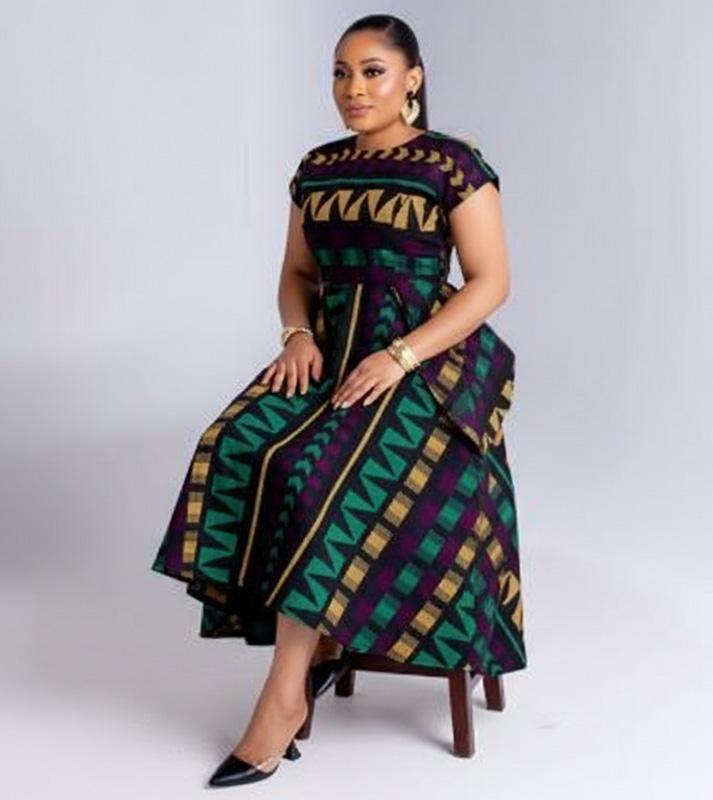
African-inspired fashion

Akwete Weaving

The Loom as the Original One Binary System

To see how weaving and coding connect, we need to start with the basics of computing: the binary system. Modern computers use two states: 0 and 1, Off and On. Everything on a screen, from a text message to a video game, is made from billions of these tiny switches.

Surprisingly, weaving works in a similar way. The main action on a loom is a simple choice between two options.

The warp threads, which run vertically, are kept tight. The weft threads, running horizontally, pass through them. At each crossing, the weaver chooses to go over or under, up or down, visible or hidden.

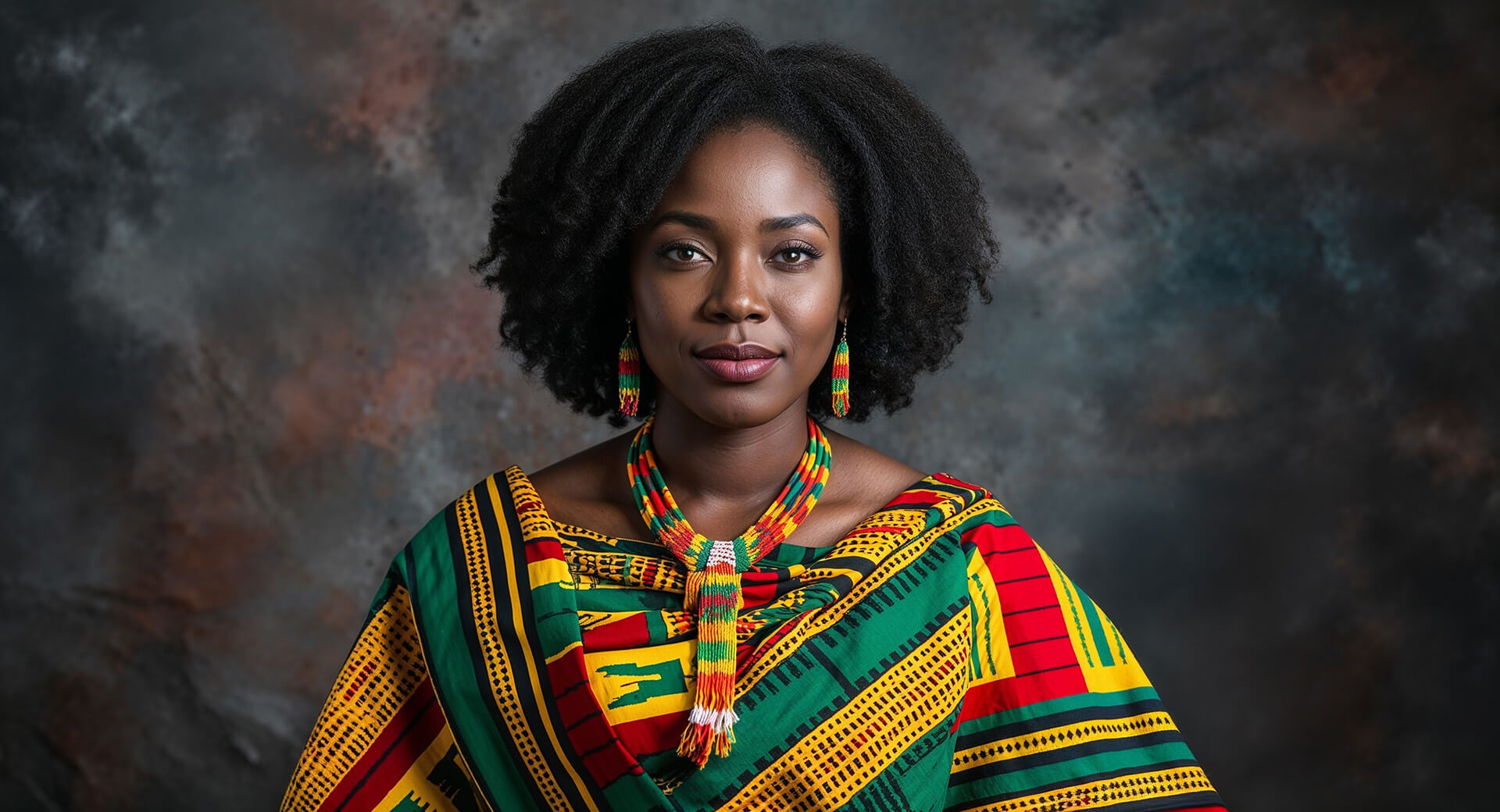
Traditional african attire portrait vibrant kente headwrap and dress

Traditional african attire portrait vibrant kente headwrap and dress

This process is like the source code for the cloth. Every pattern, no matter how complex, comes from thousands of simple, ordered choices, just like lines of code in a computer program.

Historians often say the 19th-century Jacquard loom was the first step toward computers, but African weavers were already running complex ‘programs’ in their minds much earlier. Instead of using punch cards, they memorised patterns, worked out detailed sequences, and wove them with great skill.

Kente: Building Blocks of Meaning

The tradition of Ghana, practised by the Ashanti and Ewe peoples, presents a perfect example of what designers call “modular design”.

In the digital world, we break down complex systems into smaller, manageable parts that we can rearrange. Kente weavers do something similar. Instead of making one large sheet, they weave long, narrow strips, usually about four inches wide.

After weaving, the strips are sewn together side by side, allowing for creative designs. Patterns in each strip can be shifted or mirrored to make new looks. Each arrangement offers many possibilities and tells its own story.

The names of Kente patterns show that it is more than just fashion; it is also an information system. The cloth holds meaning and tells stories.

“Fathia Fata Nkrumah” is a pattern celebrating the marriage of Ghana’s first president to Fathia of Egypt, thereby recording political history in thread.

“Sika Dwa Kofi” (The Golden Stool) represents the soul of the Ashanti nation.

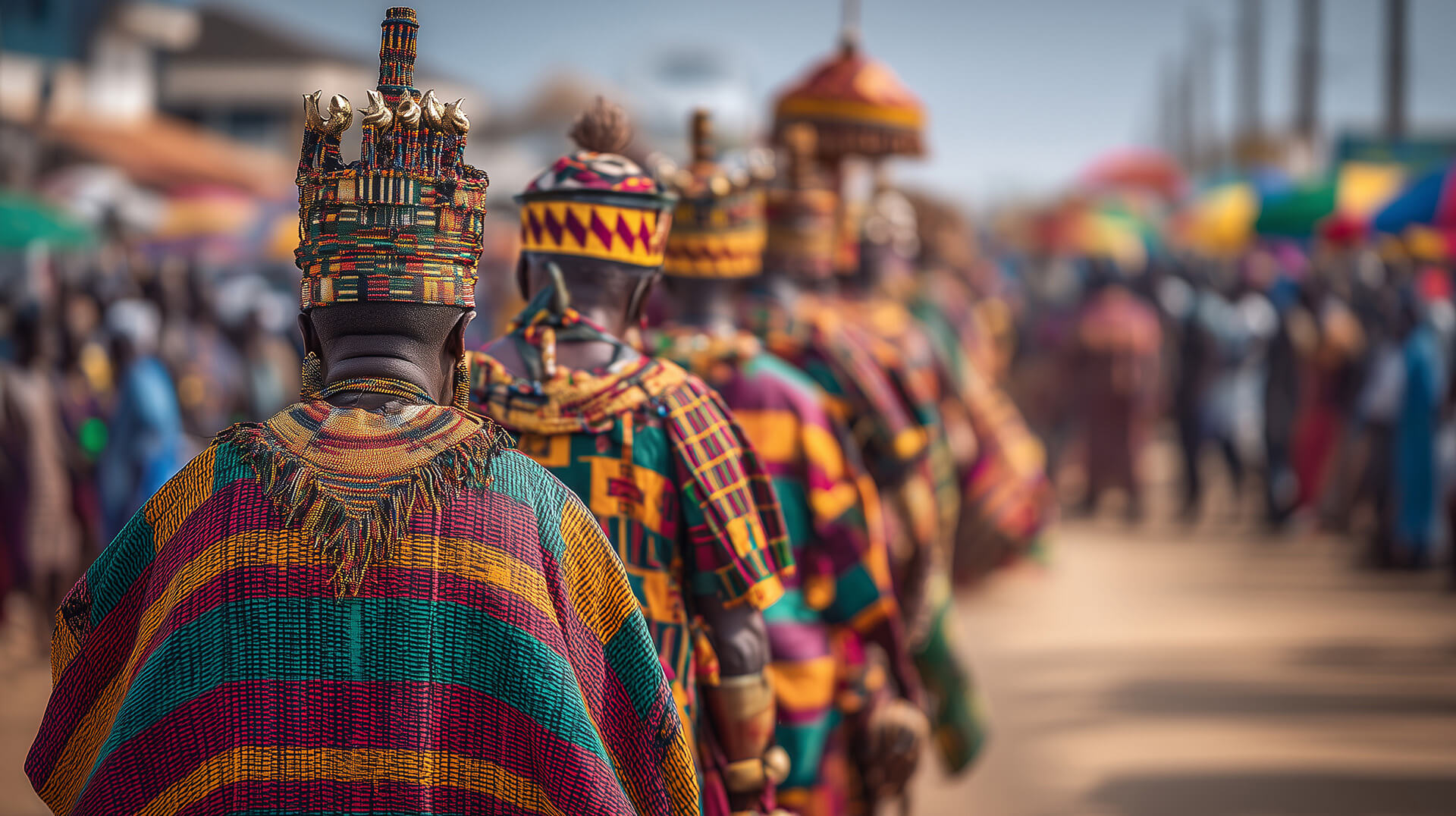
Fetu Afahye Festival Ghana traditional chiefs in colorful kente cloth parade cultural heritage celebration African royalty ceremony Cape Coast festival

Fetu Afahye Festival Ghana traditional chiefs in colorful kente cloth parade cultural heritage celebration African royalty ceremony Cape Coast festival

One of the most impressive patterns is “Adwini Asa”, meaning “All motifs are exhausted.” In this design, the weaver aims to include every known geometric pattern in a single cloth. It shows great skill and memory, a real-life encyclopedia of the weaver’s knowledge.

The Ewe tradition of Kente goes even further, weaving images of hands, combs, and animals into the geometric grid. Creating a curved shape, such as a hand, using only vertical and horizontal threads requires a deep understanding of the grid. The weaver breaks the curve into small steps, much like how a digital image is made of pixels. They were “pixelating” images long before computer screens existed.

Aso Oke: The Language of Social Identity

Aso Oke II Aso Oke I

If Kente shows how to make complex patterns from simple parts, the Yoruba Aso Oke (Top Cloth) tradition shows how cloth can work as a language.
In Yoruba culture, Aso Oke is a respected means of communication. It acts as a visual signal, showing your age, wealth, religion, and the event you are celebrating. Like any language, it has rules. You cannot mix the “words” (patterns) randomly without causing confusion.

The “Classic Three” styles of Aso Oke act as the basic vocabulary of this system:

  1. Sanyan: Often called the “King of Clothes,” this is made from the beige silk of the Anaphe moth. It represents the raw, natural earth. It signals seniority, traditional authority, and steadfastness.
  2. Etu: A deep indigo-dyed cloth. The name means “guinea fowl,” referring to the tiny white speckles on the blue background. This pattern signifies wisdom, calmness, and depth. It is a quiet, serious cloth.
  3. Alaari: A bright crimson cloth. It signals visibility, power, and vital life force. It is the cloth of presence.

The Aso Oke artisan relies on repetition and rhythm in their work. Patterns often show a “strip within a strip.” A big block of colour is divided by a smaller stripe, which is then divided by an even thinner thread.

Akwete 01

Akwete 01

Repeating shapes at different sizes is similar to what mathematicians call “fractals.” While Western geometry often focuses on smooth shapes like circles and triangles, African design highlights texture and repetition. The weaver measures these spaces not with a ruler, but with rhythm and counting, making a pattern that feels musical.

Akwete weaving, done by the Igbo people in southeastern Nigeria, is unique. Using a wide loom, Akwete weavers make large, detailed textiles known for their technical creativity. Their bold designs and rich textures reflect family heritage, mark special events, and continue to inspire modern fashion across Africa and beyond.

The “Human” Glitch: Perfection within Imperfection

In computer programming, a “bug” is a mistake that needs to be fixed. We expect our apps and software to be perfect and flawless. But African weaving sees “errors” differently.

In many African craft traditions, people believe only God can be truly perfect. Because of this, a small flaw, like a skipped thread or a slight change in the strip’s alignment, is sometimes left on purpose or accepted as the maker’s signature.

Today, as people question the idea of perfection in the digital world, designers are once again valuing imperfection. Generative art programs introduce randomness to avoid a uniform look. African weavers understood this long ago. The small differences in hand-woven Aso Oke, compared to the flat look of factory prints, show value and authenticity; they prove the cloth was made by hand. Here, the ‘bug’ is a mark of originality.

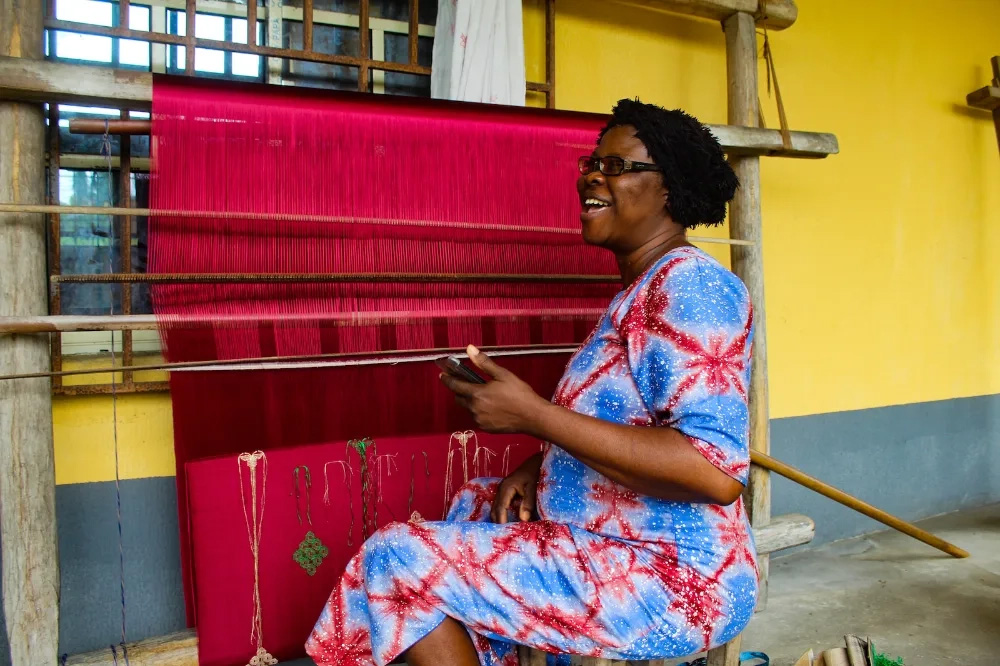
Weaver

Weaver

The Loom as Hardware, The Culture as Software

To truly understand the weaver’s skill, we need to look at their main tool: the loom. The West African narrow-strip loom is a great example of efficient engineering.

The weaver sits with the warp threads stretched out ahead, sometimes for many yards, held in place by a heavy stone or drag-sledge. This long warp stands for memory, the cloth that is yet to be made. The heddles, which lift the threads, are the controls. The shuttle, a wooden tool that carries the thread, acts like a cursor, creating each line of cloth.

But the loom is useless without its “software”, the cultural knowledge passed down through generations. This knowledge isn’t found in books; it’s learned by watching. An apprentice observes the master, picking up the rhythm of hands and feet until the logic becomes second nature.

This way of learning keeps the tradition alive while allowing for change. When a master weaver creates a new pattern to mark a modern event, like the “Obama” patterns made in Ghana in 2008, it’s similar to a software update. The old loom is used to record new history.

Ghanaian woman in kente cloth proud expression portrait photo festive landscape

Ghanaian woman in kente cloth proud expression portrait photo festive landscape

Connecting the Divide: From Loom to Laptop

Why does this comparison matter? Why should we compare a weaver to a computer scientist?

This matters because history has often ignored Africa’s intellectual achievements. When we call weaving a “craft” and coding “technology,” we downplay the skill needed to make these textiles. Recognising the logic in weaving changes this view. It shows that complex, structured thinking is not just for modern tech companies; it is part of Africa’s heritage.
Now, this connection shapes the future of African design, as digital and physical worlds come together in a new wave of creativity.

Digital Art: Today’s African artists use textile patterns to make digital art. They notice that Kente grids look a lot like the data visualisations seen in modern analytics.
New Fashion: Designers now use computer software to create textile patterns that follow the rules of Aso Oke, creating designs no human weaver has made before. This blends old logic with modern technology. Global fashion shows are embracing these trends, and major brands are inspired by the bold shapes, deep meanings, and technical details of Aso Oke, Kente, and Akwete. The influence of African weavers appears in collections from London to Lagos, Paris to New York, as designers use this digital logic in cloth and set new trends that echo the creativity of traditional looms.

Wearable Tech: As we develop “smart clothing”, clothes that can track health or change colour, the logic of the loom becomes more important. If we are going to wear our computers, then the old masters of “programmable cloth” have the most useful knowledge.

Conclusion: The Unbroken Thread
At the start, this essay promised to explore “Threads and code: weaving philosophy into cloth and logic.” We see now that these are not separate ideas. They are just different ways of speaking the same language.

The weaver sits at the loom, counting threads, measuring spaces, and balancing the tension between the fixed past, the warp, and the changing present, the weft. The coder sits at a keyboard, setting variables, building loops, and balancing the computer’s logic with the user’s needs.

Both are architects of systems, turning chaos into something understandable.

As we go further into the digital age, we should not see Kente, Aso Oke, and Akwete as just old memories. Instead, we should respect their complexity and see them as masterpieces of logic and living systems that still influence fashion, technology, and culture.

The African weaver did more than make cloth. They created an information system from cotton and silk, putting their culture’s values into a form that could travel, last, and communicate. In a real sense, they were the first creative technologists, leaving us proof that the future was never just about silicon; it was always about the thread.

The logic continues, an unbroken thread from the ancestor’s loom to the descendant’s laptop, weaving the world together, one choice at a time.


Oriiz
Oriiz is a Griot, Curator, Designer, Culture Architect, and Strategist who makes African history portable and accessible to everyone: those who know, those who question, and those who never thought to ask. He connects 8,000 years of knowledge with the present. Oriiz also edited and served as Executive Producer for The Benin Monarchy: An Anthology of Benin History (The Benin Red Book), Wells Crimson, 2019. Author: The Harbinger: A Window into the Soul of A People: 8000 years of Art in Nigeria, Crimson Fusion (2025).
:::::::: oriiz@orature.africa IG: @oriizonuwaje

From the Queen Idia Ivory Mask to the iPhone: Design as an Act of Civilisation

By Oriiz U Onuwaje

Oriiz views design as more than decoration. He sees it as a tool that shapes and stabilises power, identity, and continuity. Throughout history, people have used objects for more than beauty. They use form to pass on memory, organise authority, and make hidden systems visible. What we now call design innovation is part of a long tradition: shaping materials to carry meaning across time and place.

Continuity in Design Intelligence

Five centuries ago in Benin, court artists addressed this challenge in ivory. Today, designers address it in glass, silicon, and metal. The contexts differ. The materials differ. But the underlying ambition is strikingly similar. It is the desire to engineer form to hold power, project identity, and mediate connection past the immediate moment.

Although separated by five centuries, designers in Benin and today face the same challenge: making form carry power, identity, and connection across time and space. The materials are different, but the thinking behind the design remains the same. Time separates them, not their design intelligence.

Download PDF version of Essay
 

Benin, Authority, and Engineered Form

In the early sixteenth century, this design intelligence found one of its most refined expressions in the Kingdom of Benin, in present-day Nigeria. There, artists working within the royal court produced objects that were not exclusively ceremonial but were structurally embedded in governance, spirituality, and political identity. Among the most extraordinary of these works are the ivory pendant masks associated with Queen Idia, the Iyoba, or Queen Mother, a strong strategist whose counsel and political wisdom were instrumental in securing the reign of her son, Oba Esigie, during a period of internal conflict and external threat. Her role was active, decisive, and foundational to the kingdom’s stability.

Elephant plus Festac

The masks made to honour her were not just simple portraits. They were carefully crafted tools of leadership. The Oba wore them during key ceremonies to affirm lineage and clarify authority, linking political power to maternal heritage and family continuity. These objects fit into the court’s complex traditions. They served as spiritual tools, political symbols, and wearable signs of royal legitimacy.

Guild Systems and the Discipline of Continuity

This level of skill did not come from one person’s talent alone. It came from a well-organised design system within the Benin court. Artists who carved royal ivory, especially those in the Igbesanmwan guild, followed strict rules. Their job was not to express themselves, but to turn royal authority into physical form with discipline. Rules about proportions, symbols, and designs kept the style consistent over generations. This system ensured that power was always presented clearly and consistently.

The fact that several Queen Idia masks still exist today shows how strong this system was. The masks are not exact copies, but they share a clear style. There are small differences, but all within set rules. This consistency shows a workshop culture grounded in standards, careful supervision, and the passing down of skills. Even before the term ‘industrial design’ was used, Benin’s guilds understood that authority relies on reliable quality. The form had to be steady enough to be recognised, but still lively enough to have presence. This balance was intentional.

Queen Idia side 02

Material Hierarchy and the Meaning of Ivory

In the Benin court, the choice of materials was always deliberate and meaningful. Ivory, which is bright and rare, stood for purity, prestige, and spiritual power. Its light colour reflected light in a special way, making carvings seem to glow during rituals. Using ivory for royal and ancestral objects imbued the material with a sense of hierarchy. The meaning was part of the substance itself.

This idea is still important in design today. Some materials are chosen for objects meant to last, stand out, or show high status. The choice affects both how things look and how they feel. Materials influence how people see, touch, and value an object. In Benin, ivory was used because it could carry both deep meaning and a strong physical presence. It made authority feel real.

Choosing ivory for the Queen Idia masks made them even more important as symbols of royal legitimacy. The material showed that these were not ordinary items, but objects connected to the heart of the kingdom’s spiritual and political life. With choices like this, design became more than just looks—it became a way to show hierarchy, tradition, and belief.

Design as Mediation Betwixt Worlds

The design skill seen in the Benin court was not limited to its own time. It addressed a problem that still exists: how can form represent larger systems? Objects that last are rarely just neutral things. They help build trust, show identity, and give shape to things people can’t always see. In any society, design helps make authority clear and continuity visible.

What changes over time is not the purpose of design, but the world it works in. As societies become more complex, the hidden systems that shape daily life grow as well. These systems have shifted from spiritual beliefs and royal families to financial networks, digital systems, and global communication. Designers still work where people meet these big, unseen forces. Their job is much the same: to shape materials that connect individuals to what they cannot see.

The Contemporary Interface

Few modern objects show this ongoing design challenge as well as the smartphone. Made to be carried everywhere and used all the time, it has become the main link between people and the complex systems that shape our lives. Through smartphones, people connect to communication, money, social identity, and huge amounts of information beyond what they can see. It is more than just a device—it connects human experience to hidden systems.

These objects matter not just for what they do, but also for how they are designed. They are made to feel easy to use, reliable, and personal. Their materials, shapes, and appearance are carefully chosen to help people build a lasting connection with them. In this way, today’s devices follow the same design thinking as Benin’s court artists long ago. The form helps connect people to systems of power, meaning, and relationships that go beyond what we can see.

Queen Idia side 02

The iPhone as a Contemporary Example

The iPhone stands out as a clear example of this design culture. Its consistent look around the world, careful design, and role as a daily companion for millions show how much design shapes identity and interaction today. Its importance is not just about being new. It continues an old human goal: making objects that hold meaning, build trust, and move between different settings without losing their identity or authority.

Like the Benin court, which used a set visual style to keep power recognisable, today’s design systems rely on consistency to build trust and familiarity, even across great distances. The scale and networks are bigger now, but the main design ideas are the same. Form is not just something to look at. It actively shapes how people experience the world.

Global Circulation and Systems of Value

The travels of these objects show that design can go beyond its first home. Today, Queen Idia masks are in major museums around the world, seen as great works of human creativity rather than oddities. Their movement raises tough questions about history and ownership, but their place in global museums also shows the lasting power of their design. They still draw attention, respect, and authority far from where they were made.

Oba Akenzua II

In another sense, today’s devices circulate through global markets as markers of technology and social status. They work in business systems, not rituals, but both kinds of objects show that design can cross cultures and settings while keeping its power. When form brings together meaning, material, and identity, it can travel and fit into new systems without losing what makes it special.

The Unbroken Logic of Design

Comparing a Queen Idia mask and a modern smartphone is not just about technology. It shows a shared way of thinking. Both come from design traditions that use form to carry hidden meanings. Both show how objects can connect people to bigger systems. They remind us that design is not just about looks or use, but about shaping power, identity, and lasting connections.

Materials have changed. The size and settings have changed. But the main ideas behind design have stayed much the same. For five hundred years, designers have faced the same challenge: making form hold meaning, making material carry memory, and creating objects that can move through time and place without losing their power.

In this way, design is like a language for civilisations. Its rules remain in effect, even when the materials change.


Oriiz is a Griot, Curator, Designer, Culture Architect, and Strategist who makes African history portable and accessible to everyone: those who know, those who question, and those who never thought to ask. He connects 8,000 years of knowledge with the present. Oriiz also edited and served as Executive Producer for The Benin Monarchy: An Anthology of Benin History (The Benin Red Book), Wells Crimson, 2019.

::::::::oriiz@orature.africaIG – @oriizonuwaje
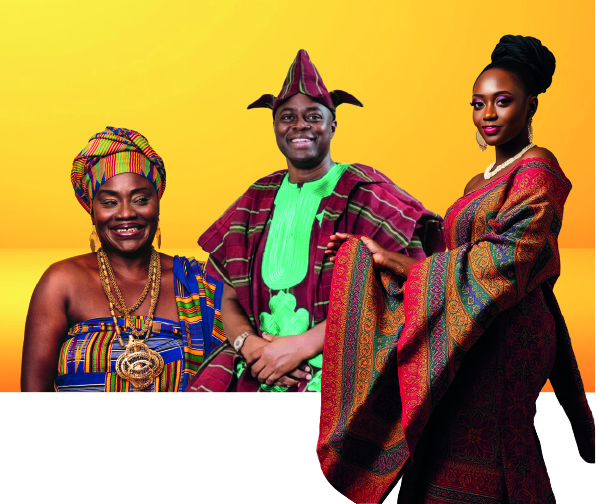
Rhythm: Retailing and Democratising Memory

By Oriiz U Onuwaje
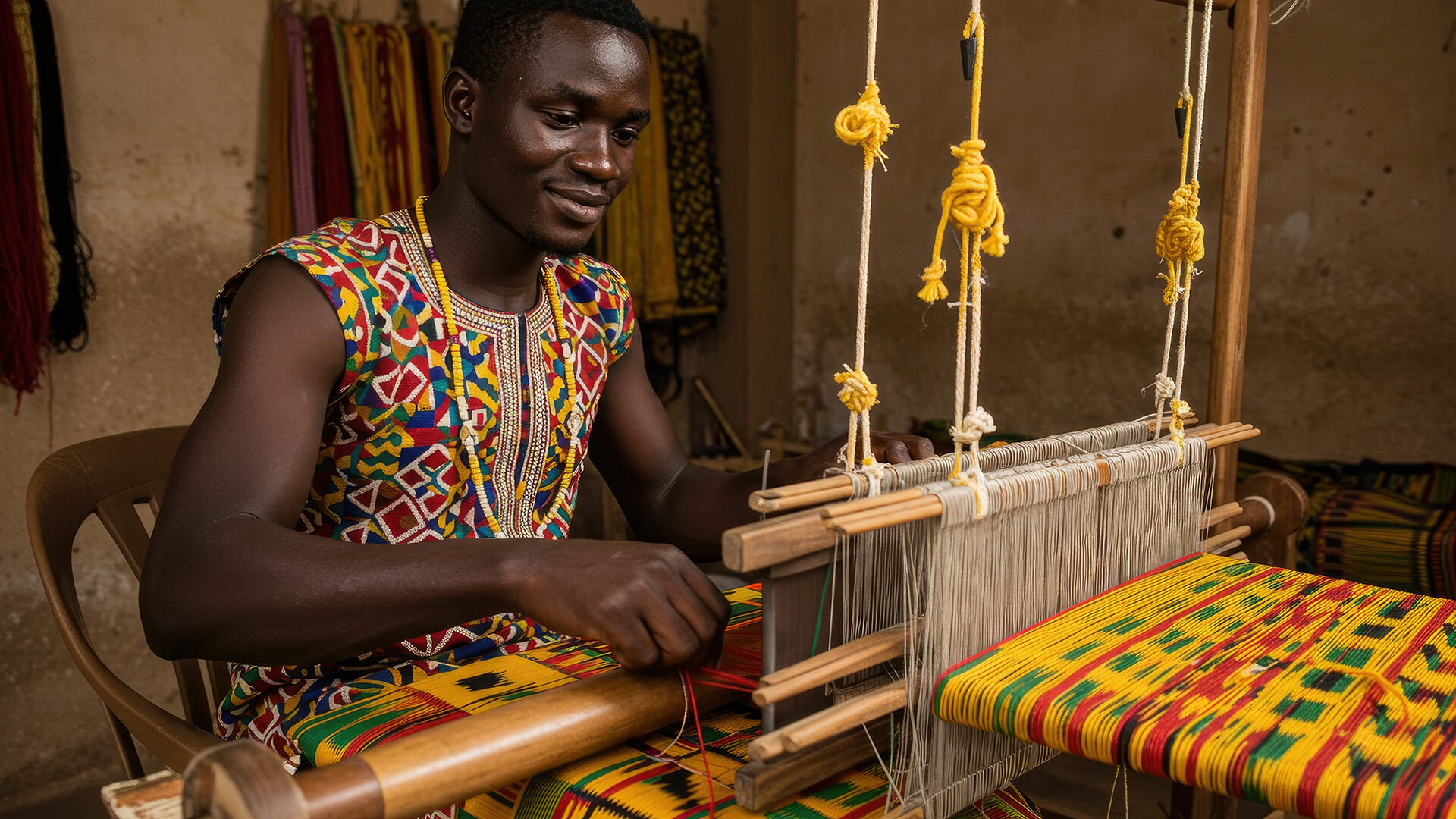
Oriiz presents Rhythm as a means of keeping traditions alive, showing how people remember and share what they cannot easily put into writing. Across Africa, rhythm acts as an archive, a form of governance, and a social bond, carrying memory in a way everyone can access, repeat, and protect.

Rhythm is more than a mood or background sound. It makes civilisation something you can hear and feel.

Download PDF version of Essay
 

Rhythm is More Than Entertainment

Rhythm is more than entertainment. It is a system.

Before libraries and paper could keep records, societies found ways to store what mattered. Rhythm was kept not for decoration but for survival. People remembered not just for nostalgia but as a foundation for their lives.

In Africa, especially, where oral traditions evolved into complex societies, rhythm became a lasting means of maintaining identity, continuity, and order. Rhythm carries knowledge that can travel, encodes meaning that people can repeat, and helps the body remember what the mind might forget.

At its core, rhythm is the democratic technology of memory.

Gene

Why Rhythm Matters for the unBROKEN Thread

Rhythm is essential to the unBROKEN Thread.

The unBROKEN Thread is not merely a museum of old facts. It shows that Africa’s past remains active, shaping identity, creativity, ambition, and relevance today.

To share and open up memories for everyone, we need to use tools people already have. This means not just using libraries and classrooms, but also rhythm, patterns, repetition, and learning through experience.

Democratic does not mean simple or watered down. It means everyone can access it fully, without barriers.

To retail memory is to bring it out of private spaces and into everyday life. This makes heritage part of daily experience, turning knowledge into a real connection and a lasting tradition. It makes our collective history available to everyone, so people can feel heritage rather than just study it.

That’s why rhythm is not a side path in heritage work. It is one of the most reliable ways to connect with it.

Rhythm as Technology

Technology is not only about machines. It is any method that helps people keep, share, organise, and pass on meaning. In this way, rhythm is a powerful technology. It does not need literacy or electricity. It does not rely on institutions or need anyone’s permission. Rhythm moves through people, not buildings. It survives harsh climates and political times that destroy paper or silence speech. Rhythm stays visible and whole, lasting through decades, governments, and centuries without becoming outdated.

Rhythm is democratic because everyone can use it. It is open to all, regardless of age, wealth, education, or status. Young people can learn it, and older people can keep it alive. People can repeat rhythm without needing certificates or approval from elites. Unlike archives that require special access or histories that require schooling, rhythm is always available to everyone.

Even when formal education is missing or interrupted, rhythm still teaches.

africans drums

Rhythm as Archive in Nigeria Today

Today in Nigeria, many people lack the literacy needed to use textbooks as a national memory. Still, the country knows itself through rhythm. Even those who have never read history can sense their heritage. They can hear belonging, feel their roots, and know when a sound is meaningful or empty. This is not a weakness, but proof that our civilisation kept its memory safe from any policy.

Today, people often trust only what is written: pages, books, certificates, and stamps. Many believe that if something is not written, it is not serious or reliable. But writing is neither the oldest nor the strongest way to remember. Ink fades, libraries burn, paper decays, digital files fail, formats change, and institutions can fall.

But when rhythm is part of people and communities, it renews itself.

Repetition as Civilisation

People might lose rhythm, but it cannot be taken away like physical archives. No one can silence rhythm without silencing the people. Rhythm is both a storehouse and a defence. It is more than an activity; it is a way for people to stay unbroken.

To see rhythm as memory, we need to see repetition as the heart of civilisation. Civilisation is not exclusively about monuments, but about systems, patterns, and discipline. It is the ability to maintain consistency over time. Repetition turns meaning into structure, structure into identity, and identity into continuity.

That’s why rhythm was as important as law in ancient societies, and sometimes even more so. Rhythm shaped work, rituals, court life, and collective efforts. It measured time, organised actions, and trained people to work together. Rhythm fostered shared feelings and understanding. In many African settings, sound did more than communicate; it shaped, authorised, and structured the community, making large-scale cooperation possible.

African kid and drum

The Drum as Institution

The drum, especially, often served as an institution.

Calling the drum merely ‘music’ misses its true purpose. The drum could call people together, warn them, announce events, and set the community’s mood. It can signal permission, restriction, change, emergency, and authority. A society that can create such signals is not primitive—it is sophisticated and organised.

Drums

The Talking Drum

Because of this, the Talking Drum can change a room’s mood in seconds. It does more than communicate—it creates authority. It can praise someone, call them by name, or warn the group. In many places, it serves as an unwritten constitution, giving meaning, rank, and consequences through sound.

In today’s terms, it works like a ringtone—a coded signal that calls certain people to pay attention, respond, and be recognised.

When people know the codes, they respond automatically. They do not have to think about it; their bodies know what the community has agreed. At that moment, the drum is proof that African societies built systems strong enough to guide behaviour without writing and refined enough to keep identity alive through repetition.

The Body as Memory

But rhythm does more than govern. It carries personal identity, stories, and the emotions of a people. It can hold both gentleness and authority. Rhythm can highlight a special moment or bring order to a group.

Rhythm also turns memory into something you feel in your body. Most archives keep memory outside of us, in shelves and vaults. But embodied memory is different; it makes identity something you carry inside. The body becomes a book, muscles are akin to pages, breath is punctuation, and steps are like sentences.

A dancer does not just show culture; they hold it within themselves.

That’s why rhythm can be an archive even when language changes. Words may change or disappear, but the body retains its knowledge. Gestures, timing, and the way things are formed remain the same. Even if people must speak another language, rhythm can preserve their original way of expression. It becomes a hidden current of identity.

When Rhythm Carries a Nation

This is not simply a theory; it is something we can see in history.

When apartheid tried to silence South Africa, rhythm did not give in. It wasn’t just a hobby but a way to survive. It wasn’t a distraction but a declaration. People under pressure protected themselves by protecting their music. Rhythm carried what could not be spoken, kept spirits up, upheld dignity, and preserved identity as living proof.

Ipi

Think about what Ipi Tombi accomplished. It did more than show dance—it made South African culture visible to the world when identity was under threat. It became a symbol of beauty and proof of civilisation. It revealed what oppression tried to hide: depth, order, sophistication, and human brilliance where others tried to diminish them.

Judith Burrows

Also, think of Hugh Masekela. His music wasn’t just for entertainment; it told stories and bore witness. It carried South Africa’s emotional truth across borders. When governments use confusion to control, truth needs to be portable. Music did that. It carried memory in a way that could not be banned, turning sound into a record.

Bob Marley

Now think about Zimbabwe. One of the most powerful moments in modern African memory was Bob Marley’s performance at Zimbabwe’s Independence celebrations in 1980. That was more than a concert; it was a ritual of renewal. Marley’s song ‘Zimbabwe’ did not merely speak of independence; it made people feel it deeply. It turned a political event into a shared memory. Independence is not just won; it is remembered, ritualised, and carried forward.

Rhythm helps people celebrate victory, not just survive hardship.

Fela Anikulapo Kuti

In Nigeria, Fela Anikulapo Kuti is widely recognised as a clear example. Nigeria has seen many governments and slogans, but few cultural forces have made truth as lasting as Fela’s. He did not just criticise the state—he created a musical republic alongside it. Afrobeat became a new kind of constitution, a language of satire, courage, warning, and public truth.

Fela made civic resistance feel human. He turned complex politics into rhythm. He made the street feel like a parliament and music into proof. Even people who could not read political documents could understand his music. That is democratic memory at work.

Music is One of the Evidence

That’s why music is not the only part of the unBROKEN Thread, but it is an important piece of evidence. Rhythm is one of the clearest records of African continuity.

But there is a warning here. Modern life can make rhythm less meaningful. When rhythm is taken out of context and used only for entertainment, it loses its depth. If the drum is merely a show, it loses its power. If dance is only a trend, it loses its memory. That’s why the unBROKEN Thread must be careful. Rhythm should be explained and shown as evidence, not merely as background.

This is not about making heritage just a feeling. It is about turning feelings back into heritage.

Conclusion:

Because rhythm is a kind of technology, it can be improved—not by replacing it, but by strengthening it. Rhythm can be combined with essays, artefacts, wall labels, documentaries, and modern design. It can help young people connect with heritage without feeling forced. Rhythm can make history inspiring without making it weak. It can make heritage appealing without losing its meaning. Rhythm can bridge ancient knowledge and contemporary creativity.

Rhythm is the democratic technology of memory because it turns survival into beauty and beauty into a permanent tradition. It shows that culture is not just what we keep in museums. Culture is what we repeat until it feels natural. Culture is what we live by until it becomes who we are.

And perhaps the most important truth is this: rhythm is not just something we do; it is part of who we are. Rhythm helps memory endure without needing approval. It keeps identity strong under pressure. Rhythm is how people stay unbroken.


Oriiz is a Griot, Curator, Designer, Culture Architect, and Strategist who makes African history portable and accessible to everyone: those who know, those who question, and those who never thought to ask. He connects 8,000 years of knowledge to the present.